
From Refugees To Citizens At Home
Price range: 0 $ through 35 $
This is a proposed plan for the return of Palestinian refugees to their homes. It is not Utopia. It is an attempt to bring peace to a region torn by strife and destroyed by war brought to it by foreigners armed with weaponry, money and political clout. The primary victims of this unholy endeavor have been the Palestinians, since their destruction and uprooting in al Nakba of 1948.
AuthorSalman Abu SittaPublisherPalestine Land SocietyDate2001No. of Pages20
Books Chapters
This plan presents a practical, justice-based framework for the return of Palestinian refugees—a right denied since the 1948 Nakba, when foreign-backed forces systematically displaced them, erased their homeland, and imposed an apartheid regime. While Israel and its allies perpetuate false claims to justify this injustice, international law and moral principle unequivocally support repatriation. Here, we debunk myths, demonstrate the feasibility of return, and prove that lasting peace demands nothing less.
This is a proposed plan for the return of Palestinian refugees to their homes. It is not Utopia. It is an attempt to bring peace to a region torn by strife and destroyed by war brought to it by foreigners armed with weaponry, money and political clout. The primary victims of this unholy endeavour have been the Palestinians, since their destruction and uprooting in al Nakba of 1948.
The Palestinian Nakba is unsurpassed in history. For a country to be occupied by a foreign minority, emptied almost entirely of its national majority, its physical and cultural landmarks obliterated, its destruction hailed as a miraculous act of God and a victory for freedom and civilized values, all done according to a premeditated plan, meticulously executed, financially and politically supported from abroad, and still maintained today, 53 years later, with the same vigour, is no doubt unique.
Yet after over half a century of suffering, the Palestinians remain adamant in their determination to return home, in pursuit of the most elemental principles of justice.
Who prevents them from returning? Israel, and the US backing it. The absolute majority of the world governments, and greater majority of the world’s peoples, support their right to return.
The Israelis advance all kinds of arguments and claims against their return. They claim that the Arabs are the aggressors, they deserve what they got, that little David is fighting for his existence against the Arab Goliath, that there is no room now for the returnees, that the villages are destroyed and boundaries lost, that the return of the refugees will pollute the “Jewish character” of Israel and so on.
That was the consistent staple of Zionist propaganda for years. Two striking observations may be made here. First, that all these arguments and claims are false and groundless. Much of the proof is provided by Israelis themselves. Second, that even if they were true, they do not diminish the Palestinian refugees’ right to return to their homes. Neither the cause of war, the absolute destruction of their houses, the settlement of their homes by foreign immigrants, nor the maintenance of an exclusive apartheid regime in Israel, are grounds for denying an Inalienable Right as the return home.
This extraordinary defiance of all civilized values and international law has led to a legacy of death for hundred of thousands, destitution of several millions, waste of billions of dollars in arms and ruined economies, and instability of the region which reflected itself in many capitals of the world.
Should we allow this to continue? Should the majority remain hostage to the minority? Can any free man in the world afford to stand by and watch this carnage?
Having allowed war, coercion and political conspiracies to take their course to no avail, is it not time to go back to the first principles of law and justice and give them a chance?
This plan is intended to do that. It first shows that Israelis claims against the return of refugees are false or inapplicable. Then it shows that the return is feasible and possible to the last detail. Above all, it shows that the return brings peace for all time.
Getting rid of the native inhabitants of Palestine has long been one of the tenets of Zionism.1 It was clearly spelled out by Yosef Weitz, the head of the Transfer Committee and the chief of land-confiscation operations. As early as 1940, he proposed an ethnic cleansing plan: “The only solution is to transfer the Arabs from here to neighbouring countries. Not a single village or a single tribe must be left”.2
Plan Dalet was designed to “occupy… expel”3 the Palestinian people. It was David Ben-Gurion’s doctrine that the destruction of the Palestinian people and their cultural and physical landscape was the precondition for creating the state of Israel on its ruins.4 The systematic elimination of the Palestinians in 1948 took the following forms:
2.1 Military Plans for Jewish Settlement
As early as January 1948, four months before the official war began, the Zionists prepared plans for the settlement of 1.5 million new immigrants over and above the existing 600,000 Jews, two-thirds of whom were themselves recent immigrants under the British Mandate. During the Jewish military operations that followed the UN partition resolution of November 1947 and before the end of the British Mandate, more than half of the Palestinian refugees were expelled. The settlement agencies headed by the Jewish National Fund (JNF) directed the military attacks to acquire coveted land, such as the villages of Indur, Qumiya, Ma’lul, Mujaidil and Buteimat in Galilee, which were destroyed primarily to grab their land.5
2.2 Physical Elimination of the Refugees
Almost every one of the thirty-odd Zionist/Israeli military operations was accompanied by a massacre of civilians. There were at least thirty-five reported massacres,6 half of which took place before any Arab regular soldier set foot in Palestine. The most notorious of these massacres is Deir Yassin, the largest is Dawayma, and the latest disclosed by an Israeli researcher, Teddy Katz, but known to Palestinians all along, is Tantoura.
Shooting of civilians was not restricted to wartime. After the fighting ceased, some of the refugees tried to return home to rescue civilians left behind, to retrieve some belongings or to attend to crops or cattle. These returnees were shot on the spot as “infiltrators”. The UN truce observers reported hundreds of such cases.7
2.3 Plunder and Destruction of Property
Plunder took place in the immediate aftermath of military assaults, especially in cities such as Haifa, Jaffa, Lydda, and Jerusalem. The looters included nearby kibbutzniks, Israel Defense Forces (IDF) brigade commanders and the high-ranking political figures of the ruling Mapai (Labor) party.8 There followed a massive campaign of destruction, which lasted over fifteen years and in which 53 percent of the 418 villages surveyed were totally destroyed and 44.5 percent partially destroyed.9 The clear aim of this destruction was to prevent the return of the refugees.
2.4 Political Action
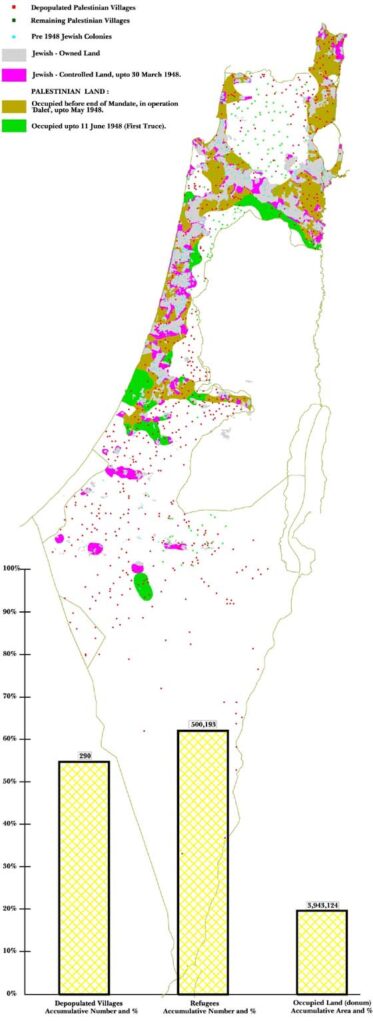
Soon after the state of Israel was declared on May 14, 1948 and following the protest of UN mediator Count Folke Bernadotte, who witnessed, by June 1948, the expulsion of about 500,000 refugees, the Provisional Government of Israel stated that it could not allow any refugees to return before a peace treaty was signed, on the pretext that these refugees would be a “security threat”. Even after the fighting stopped, Israel refused to re-admit the refugees, and it maintains this position in the international arena to this day. It does so even though Israel’s admission to the UN in May 1949 was unique in that it is the only UN member whose admittance is “conditional” upon the return of refugees (Resolution-194) and withdrawal to the lines of the partition plan (Resolution-181).10
2.5 Creation of a Fictitious Legal Web to Mask Illegal Confiscation
Before, during and after the 1948 war, Israel/Zionists resorted to many pseudo-legal devices to organize and justify the confiscation of 18,700 square kilometres (92 percent of Israel) of Palestinian land, in addition to the property found in 530 depopulated towns and villages. The property was held by the Custodian of the Absentee (i.e. refugee) Property and transferred later to the Development Authority. All such land, as well as JNF holdings, is now administered by the Israel Land Administration (ILA). According to Israel, the “Absentee” is a Palestinian refugee not allowed by Israel to return. The term also applies to Palestinian citizens of Israel, who are not “Absent”, hence dubbed “Present Absentees”; much of their land has also been confiscated.11
2.6 Importing of Jewish Immigrants to Fill the Depopulated Villages
Immediately upon the invasion of Palestinian villages, Israel activated its program of sending Mossad agents to transport Jews in Arab countries to Israel. The immigrants were persuaded by a mixture of rosy promises, incentives, and, for the reluctant ones, various acts of coercion, including throwing grenades at their houses.12 About 700,000 Jewish immigrants arrived in the period 1949-52. Many of them were unhappy about the discriminatory treatment they received at the hands of the ruling Ashkenazi. Their resentment is still strong today.
All these actions were designed to prevent the return of refugees to their homes. While Israel was successful in preventing their return, the refugees remained adamant in their intention to return. They could often see their old homes across the barbed wire of the armistice line; indeed, most refugees still reside within a two-hour bus ride of their homes. After their expulsion during al Nakba of 1948, the problem for Israel thus became how to get rid of the refugees themselves, wherever they may be in exile.
Footnotes (↵ returns to text)
- Nur Masalha, Expulsion of the Palestinians: The Concept of ‘Transfer’ in Zionist Political Thought, 1882-1948, The Institute for Palestine Studies, (Washington, DC, 1992). ↵
- Central Zionist Archives, Weitz Diary, A 246/7 entry for December 20, 1940, pp 1090-91. More explicit statements are found in the unedited manuscript of the Weitz Diary. Cited in Nur Masalha, “An Israeli Plan to Transfer Galilee’s Christians to South America: Yosef Weitz and ‘Operation Yohanan’ 1949-1953”, Center for Middle Eastern and Islamic Studies, University of Durham, Occasional Paper No. 55, 1996. ↵
- W. Khalidi, “Plan Dalet: Master Plan for the Conquest of Palestine”, in Journal of Palestine Studies, Vol. 18, No. 1, Autumn 1988, pp. 3-70. Benny Morris, The Birth of the Palestinian Refugee Problem 1947-1949 (Cambridge, 1987). Michael Palumbo, The Palestinian Catastrophe (London, 1987). ↵
- Nur Masalha, A Land without People: Israel, Transfer and the Palestinians 1949-1996, Faber and Faber (London, 1997). ↵
- For various instances of ethnic cleansing, destruction of villages and land confiscation, see Meron Benvenisti, Sacred Landscape: The Buried History of the Holy Land (Berkeley, 2000, pp. 102-209). ↵
- S. Abu Sitta, “The Palestinian Nakba 1948: The Register of Depopulated Localities in Palestine”, The Palestinian Return Center, London, 2nd edition, 2000, pp. 16-20. ↵
- UN Archives 13/3.3.1 Box 11, Atrocities; S. Abu Sitta, “Jewish Carnage Policy Aimed to Evacuate the Galilee Palestinians as Mentioned in the UN Truce Observers Reports in 1948”, al Hayat (London), February 6, 2000, p. 10. ↵
- Ben-Gurion War Diary, entries for February 10, May 1, June 17 and July 15, 1948; Tom Segev, The First Israelis-1949 (Arabic trans.), Institute for Palestine Studies, 1986, pp. 86-88, 98; Benvenisti, Sacred Landscape, p. 165. ↵
- Ghazi Falah, “The 1948 Israeli-Palestinian War and Its Aftermath: The Transformation and De-Signification of Palestine’s Cultural Landscape”, Annals of the Association of American Geographers, June 1996, Vol. 86, No. 2. ↵
- UN RESOLUTION No. 273 (III) of 11 May 1949 states: “Recalling its resolution of 29 November 1947 [No. 181, the Partition Plan] and 11 December 1948 [No. 194, the refugees’ repatriation] and taking note of the [Israeli] declarations… in respect of the implementations of the said resolutions… ”, Israel was admitted to the UN. See detailed discussion of UN resolutions regarding the Right of Return in W.T. Mallison and S.V. Mallison, “The Right of Return”, Journal of Palestine Studies, Vol. 9, No. 125, Spring 1980, pp. 125-36. See the full version of the paper in: “An International Law Analysis of the Major UN Resolutions Concerning the Palestine Question”, UN Doc. ST/SG/SER.F/4, UN Sales #E. 79.I.19 (1979). See also Kathleen Lawand, “The Right of Return of Palestinians in International Law”, International Journal of Refugee Law 4 (1996). For full review of the literature on The Right of Return, see Gail J. Boling, “Palestinian Refugees and the Right of Return: An International Law Analysis”, Badil brief No. 8, January 2001, and Badil Occasional Bulletin No. 5, April 2001, Badil Resource Center, Bethlehem, Palestine. ↵
- S. Abu Sitta, “Confiscation of the Palestinian Refugees’ Property and the Denial of Access to Private Property”, Memorandum submitted to the UN Social, Economic and Cultural Rights Committee, BADIL submission, November 14, 2000, Geneva. See John Quigley, Palestine and Israel: A Challenge to Justice (Durham, 1990) and George E. Bisharat, “Land, Law and Legitimacy in Israel and the Occupied Territories”, The American University Law Review, Vol. 43, pp. 467-591. ↵
- For details of terrorizing Arab Jews by Mossad, see Naeim Giladi, The Link, Vol. 31, Issue 2, April-May 1998, New York; and Marion Woolfson, “Prophets in Babylon: Jews in the Arab World”, Faber and Faber, London and Boston, 1980, pp 186-190. ↵
The Palestinians’ dispossession and wholesale ethnic cleansing of the population is unparalleled in modern history. It is called al Nakba, a Palestinian holocaust.
The gravity of this catastrophe is amplified by the fact that it was not a single act of war (as the case for Nazi atrocities). It is in fact a premeditated, carefully executed and continuous process still being carried out to this day, 53 years after the first onslaught in 1948. Reading the newspapers today or watching the TV news is a grim reminder of the same dispossession and expulsion of 1948, albeit on a different scale, style and location.
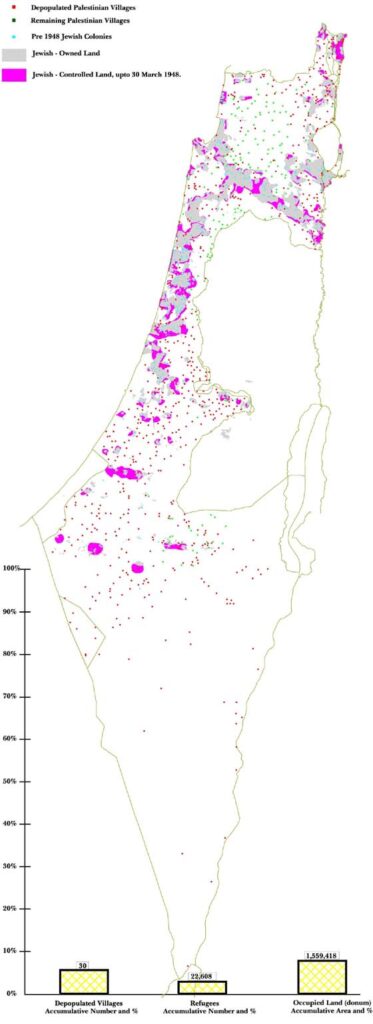
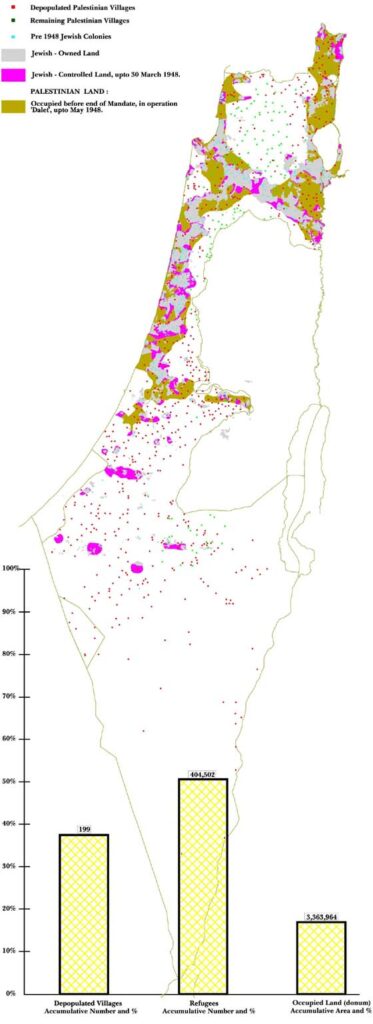
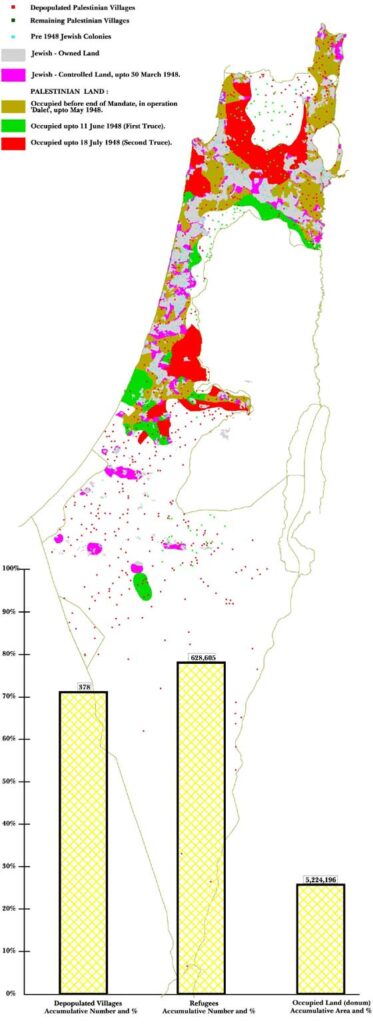
It is therefore important to understand how the original Nakba took place. This is best illustrated in a series of maps.
The period from the passing of the Partition Plan (UN Resolution-181) on 29 November 1947 to the onset of the Zionist invasion (Plan Dalet) around the end of March 1948 [Fig-1]:
The land under Jewish possession did not exceed 6% of Palestine. The Zionist forces started occupying nearby Arab villages to provide continuity and expand Jewish-held territory. The population of 30 villages were expelled. Naturally, all such territorial expansion, initiated by the Jews only, took place at the expense of Arab land.
From the Zionist invasion according to Plan Dalet, in early April, to the end of the British Mandate and creation of the State of Israel on 14 May 1948 [Fig-2]:
Under the watchful eye of the British Mandate government, the Zionist forces initiated an organized operation for the conquest of Palestine, starting with linking up scattered Jewish colonies along the coastal strip, along Marj Ibn Amer Plain, up along the river Jordan north of Tiberias, in the form of a large N. Two hundred towns and villages were occupied and their population expelled in this period. This included key Palestinian towns: Jaffa, Haifa, Tiberias, Safad, West Jerusalem (partly). Acre was occupied a little later.
Already over 50% of the refugees were expelled before a single Arab regular soldier came to their rescue. The British Government, whose Mandate was to protect the civilians, failed to do so. The British High Commissioner, whose office was a mere 5 km away from Deir Yassin, refused to interfere in the ongoing massacre there.
The State of Israel was declared on 14 May 1948, without any specific borders, on a captured territory of Palestine, not exceeding 11%. All subsequent expansion (now 100%) is considered illegal for those countries who gave de facto recognition of Israel at the time.
Israel adopted a policy of conquest of Palestinian land, not only by military means but also by a series of fictitious pseudo-legal regulations intended to obscure the outright plunder of the land.16
In March 1948, at the initiation of the Israeli military operations, the Haganah (the forerunner of Israeli Army, IDF) created a “Committee for Arab Properties in Villages”. A similar committee was established after the Israeli occupation of the Palestinian cities of Haifa, Jaffa, Safad and Tiberias in April and May.
In November 1948, Israel completed the occupation of the most fertile and most populated areas of Palestine. In December, the same month in which the famous UN resolution 194 calling for the return of the refugees and the Universal Declaration of Human Rights were passed, Israel responded by issuing the “Emergency Regulations Relative to Property of Absentees”. Soon thereafter the Knesset passed the “Law of the Acquisition of Absentees Property”, (Absentees Property Law, 4 L. ST. Israel 68, 1949-1950). This law effectively classified all the refugees as “absent” and transferred the control of their property to a Custodian. The Custodian has the discretion to determine whether any Arab Palestinian is “absent” and confiscate his property. This arbitrary definition was applied, not only to those who were expelled beyond the Armistice Line, but was extended to Palestinians who remained in Israel. Those who remained but were not in the specified place on a particular date, for example, on a visit to the next village or had been away for a day, were declared “absent”. Since these became Israeli citizens, they were dubbed as “present absentees”, an ironical but accurate description of the Israeli fictitious legislation.
In 1950, Israel extended this appellation to all Wakf (Islamic Endowment), which was instated centuries ago, with the exception of strictly active religious shrines. Protestations that the owner–God–is “present” were to no avail. All mosques and cemeteries of depopulated villages have not been allowed to be used or repaired until this day. Many have been covered with ‘forests’, as was the case with demolished villages, to camouflage their remains. Christian and other religious bodies were left untouched.
Israel reactivated the “Defense (Emergency) Regulations of 1945”, created by the British Mandate in order to quell Palestinian revolt against British policies. Israel applied these regulations to areas in Israel in which Palestinians remained, through orders by an appointed Military Governor for each area. The regulations were not applied to Jews who lived in the same areas. Under these regulations, the Military Governor is empowered to declare that any locality is “closed”; no entry or exit from this locality is allowed.
In January 1949, the Knesset passed the “Emergency Regulations for the Exploitation of Uncultivated Lands” (Cultivation of Waste Lands Ordinance). The Minister of Agriculture is empowered to take possession of any land he considers “uncultivated”.
Further, Israel issued the “Emergency Regulations (Security Zones) of 1949” which empowered the Minister of Defence to declare most areas a “security zone”, with the power to deny entry or exit to any person or to remove him from this zone.
A further law, the “Emergency Land Requisition Law of 1949” empowered any “competent authority” to acquire any land if it is regarded as “necessary for the defence of the state, public security, essential services, absorption of immigrants or rehabilitation of ex-soldiers”.
Cases have been cited for a land coveted by the government, although the owner was legally present and cultivating his land. The land then would be declared “closed” and no person was allowed to remain there. After a period of 3 years, the government acquires the land on the pretext it was “Uncultivated”.
This sweeping acquisition of land through thinly-disguised land robbery legislation would not have been possible had it not been for the mass expulsion of refugees and the vast amount of land (92% of Israel) ready for grabs. It would not have also been possible if the country was truly democratic and the rights of the Palestinian minority were protected against racial discrimination.
To establish an intermediary between the Custodian of Absentee Property and the ultimate beneficiary, Israel created “the Development Authority (Transfer of Property) Law, 1950” to which Palestinian land was transferred. The Authority was empowered to sell, buy, lease, exchange, repair, build, develop or cultivate (Palestinian) property, provided that the beneficiary is a Jew or a Jewish entity. This excludes non-Jewish Israeli citizens also.
To validate any prior illegal expropriations, the Knesset passed the Land Acquisition (Validation of Acts and Compensation) Law of 1953. This law permitted the Minister of Finance to vest ownership of previously and newly expropriated land in the Development Authority. The law also allowed for compensation to any (i.e. Palestinian) owner at unfavourable terms. Compensation would be paid on the assessed value of the property as on January 1, 1950 in Israeli pounds of that date, +3% p.a. thereafter, minus all costs of the property “maintenance”. The values on the official list were very low and the Israeli pound was devalued many times. The exercise is highly theoretical. On a matter of principle, practically no ‘present’ Palestinians took the offer. Other laws of the same nature have been passed.
Following the Israeli occupation of Palestine, a dispute arose between JNF and the state of Israel which lasted from 1949 to 1961. JNF proposed that the acquired Palestinian land should be treated as other JNF lands, “for the Jewish people everywhere, in perpetuity”. The state considered that this land “of the Arabs who fled” belongs to it in view of “the heroic battles of the Haganah”.
JNF has the largest share of Jewish-owned land, which did not exceed 936,000 dunum (dunum = 1000 m2) in 1948. To appease JNF, Ben Gurion’s government ‘sold’ JNF 1,101,842 d. in January 1949, during 1948 war, before the first Armistice Agreement with Egypt was signed. A further 1,271,734 d. were ‘sold’ in October 1950. The last two ‘sales’ of Palestinian land, for a consideration of $1, increased JNF total holdings to some 3,400,000 d.
The conflict between JNF and the state was resolved by signing an agreement in 1961. It was agreed that JNF land and the acquired ‘state land’ to be managed by a government body, Israel Lands Administration (ILA), under the same rules adopted by JNF since 1906, i.e., denial of its use, lease, development or access to any non-Jew including Israeli citizens.
Since there is no constitution in Israel, a number of Basic Laws were enacted, including Basic Law: Israel-Lands (1960) which restricts its use to Jews only.
ILA report of 1962 gave the following figures for lands under ILA management:
| State and Development | 15,205,000 d. |
| JNF (pre-mandate + “purchase” from the state) | 3,570,000 d. |
| Land under ILA* | 18,775,000 d.(92.6%) |
| Private land (Arab and Jewish) | 1,480,000 d. |
| 20,255,000 d.(100%) | |
| (*According to the Government Press Office on May 22, 1997 this figure is 19,028,000 d.) Thus ILA manages 92.6% of the land in Israel. | |
How much of this is Palestinian?
In addition to the confiscated property of the refugees, Israel confiscated 76% of the land of the remaining villages in Israel. Therefore, confiscated Palestinian land is:
| From refugees’ land | 17,178,000 d. |
| From remaining citizens’ land | 1,113,000 d. (76% of 1,465,000) |
| 18,291,000 d. or 90% of Israel. |
The United Nations Conciliation Commission on Palestine (UNCCP), which was created by UN resolution 194, compiled the Palestinian land holding which came under Israel in 1948. A team headed by Frank E. Jarvis completed the task in April 1964 (A/AC.25/W/84 of 28 April 1964) based on British Mandate government Land Registers and in consultation with the relevant governments. According to Jarvis, the area of Palestinian land thus compiled is 5,194,091 d. But Jarvis noted that he excluded 10 blocks in Ramle and 10 blocks in Jerusalem districts17 and the whole district of Beer Sheba. Adding the area of the latter (12,577,000) and some 500,000 d. for the missing blocks, the total will be 18,271,091 d. which is similar to the above figure.
Estimates for the land now remaining in the hands of the Palestinian citizens of Israel vary between 350,000-600,000 d. This land is subject to much restrictions and discriminatory practices. Thus one million Palestinians control some 2-3% of the land, while five million Jews control 97% of Israel, or 7 times the Palestinians’ share, although this land is predominantly Palestinian.
ILA leased the Palestinian land to the Kibbutz, Moshav and other Cooperatives for 49 years. Other lands are reserved by the state for military purposes, natural reserves and future expansion to accommodate new immigrants.
The Palestinian land, now called State Land, is leased or restricted exclusively for the use of Jewish individuals or bodies, with some negligible exceptions. Professor Uzzi Ornan of the Hebrew University noted that “a Jew has right to receive land or apartment on land controlled by ILA, but a non-Jew does not enjoy this right”.18
The (Jewish) lessee is not allowed to “make non-conforming use of that land save under a written permit”, in accordance with the especially enacted law: Agricultural Settlement (Restrictions on Use of Agricultural Land and of Water). This is to prevent a Jewish lessee from sub-leasing, or allowing the use of this land to any non-Jew, including Palestinian citizens of Israel. As this applies to 92% of the land held by Israel, the restriction imposed on the Palestinians in Israel becomes quite evident.
These exclusive and racist laws have been censured by many international and human rights bodies.
It is not quite clear how much land was leased to each Jewish group. But it is clear that the Kibbutzim established before 1948 were the first to grab the best land, which typically belonged to the nearby depopulated Arab village. The total leased (termed ‘liberated’) land is about 4,500,000 d. which is comparable to Jarvis figures and is roughly equal to the Palestinian land excluding Beer Sheba. Some reports indicate that 2,800,000 d. was leased to the Kibbutzim and more than that area to the Moshav and Cooperatives. Most of the Palestinian refugees’ land is situated in the Northern and Southern Districts of Israel. There are 250 Kibbutzim (population 56,500), 217 Moshavim (population 38,800) in the Northern District, and 65 Kibbutzim (population 23,800), 112 Moshavim (population 41,400) in the Southern District–1998 figures. This shows how vast is the land leased to so few. The land leased to 160,000 Jewish settlers is the property of 5,250,000 refugees. In the words of Meron Benvenisti, “the land of dispossessed Arabs became the property of the Jewish people (everywhere and in perpetuity) according to JNF rules”.19
Footnotes (↵ returns to text)
- This section is based on presentation made to the Committee for Economic, Social and Cultural Rights, regarding the Committee’s 1998 “Concluding Observations”, Badil Submission, November 2000. For the legal background to this section, see John Quigley, Palestine and Israel: A Challenge to Justice, Duke University Press, 1990 and George E. Bisharat, Land, Law and Legitimacy in Israel and the Occupied Territories, The American University Law Review, Vol. 43, pp. 467-591. ↵
- In Ramle Urban, Jarvis used seven “settled”–i.e. reconciled with maps–blocks and only 11 out of 21 “non-settled” blocks. In Jerusalem sub-district, no Tax Distribution List was found for Bureij, half of Deiban, Jarash and Khirbet Ismallah. In addition, no Tax Distribution List was found for Beit Jamal, Deir Rafat, Lifta, Suba, Dalata, Mallikiya and Ras al Ahmar. ↵
- Quoted in Walter Lehn and Uri Davis, The Jewish National Fund, Kegal Paul International, 1988, p. 116. ↵
- Meron Benvenisti, op. cit., p. 177, 188. ↵
As stated earlier, the Israeli policy concentrated its efforts, after the expulsion and dispossession of the Palestinians and confiscating their land, on getting rid of the refugees themselves.
Today, 88 percent of the refugees live in Palestine and environs: 46 percent in British Mandatory Palestine, 42 percent in Jordan, Syria, and Lebanon, within a 100-mile radius of Israel. Only 12 percent reside further afield, equally divided between Arab and foreign countries. Their total number, according to 1998 figures, is 4.9 million, of which only 3.6 million are registered with the United Nations Relief and Works Agency (UNRWA), the official body set up to care for the refugees.20 More than two-thirds of the Palestinian people are refugees! There are no other people in the world where so many have been forced into exile.
The proximity of the refugees to their homes and their unquenched desire to return explains the feverish Israeli attempts to bring in as many immigrants as possible from such diverse places as Ethiopia and Russia, just to fill the depopulated Palestinian locations. On the other hand, there are over three dozen schemes21 (over a hundred if we consider minor variations) to resettle the refugees anywhere in the world except their homes. They are all Israeli-inspired and are based on one or more of the following premises: that the Palestinians are not a distinct “people”, that they could and should live anywhere, that they have no rights to qualify them for return, that their return is not physically possible, and that their return is not desirable because it would threaten the “Jewish character” of Israel.
The latest edition of these schemes is a proposal made by Donna Arzt.22 Although dressed in humanitarian garb, it is essentially a continuation of the ethnic-cleansing plan executed by Ben-Gurion, Weitz and Ariel Sharon. The plan calls for the transfer of 1.5 million refugees to various parts of the world and the forced exile of several million under a scheme of threats, coercion and bribery.23
There are other schemes which call for the return of the refugees, not to their homes, but to a new state of Palestine, whose sovereignty and territory are still shrouded in mystery. They even propose ‘land swaps’, such as exchanging Palestinian-populated areas in Israel, or deserts in Israel used as dumps for chemical waste, for valuable territory in the West Bank occupied by settlers to be annexed to Israel.
Such ideas confuse the issue of sovereignty, which applies to a territory in which the state can make laws to admit citizens to it, and the issue of return to the homes from which the refugees were expelled, which is an Inalienable Right. The two are entirely unrelated. The refugee remains one until he returns to his original home. This has been clearly spelled out in the Explanatory Memorandum of Resolution-194. Changing the camp address of the refugee does not make him a returnee or deprive him of his rights. A refugee should return to his home, regardless of the sovereignty of the regime where his home lies.
All such schemes have failed, and they will continue to fail. Therefore, it becomes increasingly necessary to go back to basics and find creative solutions. Such solutions can never be permanent unless based on justice. First we must break the Israeli taboo that the Right of Return is not possible. We start by examining and refuting the Israeli standard arguments against the Right of Return.
Footnotes (↵ returns to text)
- S. Abu Sitta, “The Palestinian Nakba 1948”, op. cit., p. 22. ↵
- Elia Zureik, The Palestinian Refugees and the Peace Process, the Institute for Palestine Studies, (Washington, DC, 1996). ↵
- Donna Arzt, Refugees Into Citizens: Palestinians and the End of the Arab-Israeli Conflict, Council on Foreign Relations, (New York, 1997). ↵
- For analysis of this proposal, see S. Abu Sitta, “The Return of the Refugees is the Realistic Solution”, UN International Conference on Palestine Refugees, Paris, April 26-27, 2000; S. Abu Sitta, “Between Domestication and Resettlement: The Battle of Spurious Scholarship”, al Hayat (London), in Arabic, August 6, 1997, p. 7. ↵
First, the Right of Return is perfectly legal24 in accordance with international law. The well-known UN Resolution-194 has been affirmed by the international community 135 times in the period 1948-2000. There is nothing like it in UN history. This universal consensus elevates this resolution from a “recommendation” to an expression of the determined will of the international community. International law also prohibits mass denationalization of a people if the territory in which they live undergoes a change of sovereignty.25 Thus the refugees are entitled to return to the homes they lost and to a restoration of their nationality as well. The Right of Return is supported by the Universal Declaration of Human Rights and the many regional conventions based on human rights law. It is also derived from the sanctity of private ownership, which is not diminished by change of sovereignty, occupation or passage of time.
Second, the Right of Return is sacred to all Palestinians. It has remained their fundamental objective since 1948. Their determination on the return issue has endured despite warfare, suffering, and enormous social and political hardships. In this, the refugee from Iqrit, who is an Israeli citizen, the refugee from Lydda, who is a Jordanian citizen, the refugee from Haifa, who is stateless in Syria or Lebanon, and the refugee from Jaffa, who is a US citizen, have the same determination.
Third, there is no acceptable reason why they should not return. The Israelis oppose return on the grounds that it will pollute the “Jewish character” of Israel and cause outward emigration of Jews. They say it is impossible because the refugees’ villages have been destroyed and property boundaries lost. A senior Israeli intelligence General still perpetuates this claim when he says, “while the principle of ‘return to their original homes’ was fitting and possible in 1948, it has not been a realistic option for years. Implementing it today would mean dismantling and destroying the new infrastructure built in the last 50 years”.26 None of these claims stand serious scrutiny. They are meant to perpetuate the act of ethnic cleansing. They try to derive some comfort from the dubious assumption that, while planning a crime is illegal and reprehensible, carrying it out efficiently is acceptable.
Footnotes (↵ returns to text)
- John Quigley, Palestine and Israel, op. cit; Quigley, “Displaced Palestinians and a Right of Return,” Harvard International Law Journal, Vol. 39, No. 1 (Winter 1998). Also see footnote 10. ↵
- John Quigley, “Mass Displacement and the Individual Right of Return”, British Yearbook of International Law, Vol. 68 (1997), Oxford/Clarendon Press, 1998, pp 64-125. Quigley quotes an Israeli court which gave a verdict in 1951 that “every individual and inhabitant of the ceding State becomes automatically a national of the receiving State”, p. 108. The Israeli government nullified this verdict by giving a different meaning to the “inhabitant”. Quigley shows a clear view of the international law that ‘people and territory go together’. ↵
- Shlomo Gazit, retired Israeli General, Jerusalem Post, 6 February 2001. Note that this is not a negation of the principle of the Right of Return but, rather, it is claimed that it is difficult to implement. ↵
This leaves 200,000 rural Jews who exploit vast areas of refugee land (with the remainder of the land used for military purposes and afforestation). Most of these rural Jews (160,000) are residents of the moshavim (cooperative farms) and kibbutzim (collective farms). The kibbutz, which used to be the flagship of Zionism, is now dying out. Today only 8,600 kibbutzniks live on agriculture, assisted by tens of thousands of hired labourers from Thailand, an ironic subversion of Zionist doctrine, which prohibits the employment of non-Jewish (especially Palestinian) labour.
Thus, the rights of 5 million refugees are pitted against the prejudices of 8,600 kibbutzniks.
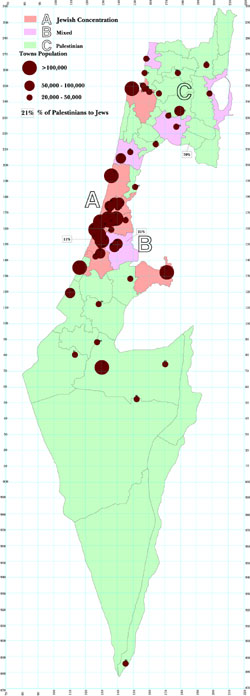
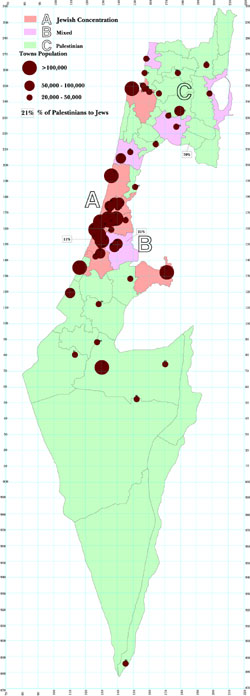
To illustrate the point further, consider this scenario: When the registered refugees in Lebanon (362,000) return to their homes in Galilee (still largely Arab) and the registered refugees in Gaza (759,000) return to their homes in the Southern District (now largely empty; rural Jewish density is 6 persons per square kilometre, compared with 5,500 persons per square kilometre in Gaza), there will be negligible effect on Jewish density in group-A, and Jews will retain numerical majority in A, B, and C.
The number of Russian immigrants brought to Israel in the nineties is equal to the number of refugees from Lebanon and Gaza combined. If the Russians had not immigrated and these one million refugees had been allowed to return home, they would be accommodated easily and Israel would maintain its present density. Instead, foreign immigrants were admitted to Israel while the rightful owners of the land have not been allowed to return to their homes.
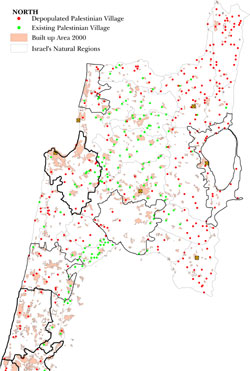
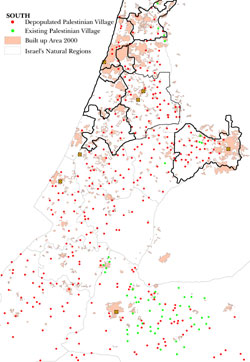
Thus the myth of lack of space could be laid to rest. [Fig-10, Fig-11]
This leaves 200,000 rural Jews who exploit vast areas of refugee land (with the remainder of the land used for military purposes and afforestation). Most of these rural Jews (160,000) are residents of the moshavim (cooperative farms) and kibbutzim (collective farms). The kibbutz, which used to be the flagship of Zionism, is now dying out. Today only 8,600 kibbutzniks live on agriculture, assisted by tens of thousands of hired labourers from Thailand, an ironic subversion of Zionist doctrine, which prohibits the employment of non-Jewish (especially Palestinian) labour.
Thus, the rights of 5 million refugees are pitted against the prejudices of 8,600 kibbutzniks.
To illustrate the point further, consider this scenario: When the registered refugees in Lebanon (362,000) return to their homes in Galilee (still largely Arab) and the registered refugees in Gaza (759,000) return to their homes in the Southern District (now largely empty; rural Jewish density is 6 persons per square kilometre, compared with 5,500 persons per square kilometre in Gaza), there will be negligible effect on Jewish density in group-A, and Jews will retain numerical majority in A, B, and C.
The number of Russian immigrants brought to Israel in the nineties is equal to the number of refugees from Lebanon and Gaza combined. If the Russians had not immigrated and these one million refugees had been allowed to return home, they would be accommodated easily and Israel would maintain its present density. Instead, foreign immigrants were admitted to Israel while the rightful owners of the land have not been allowed to return to their homes.
Thus the myth of lack of space could be laid to rest. [Fig-10, Fig-11]
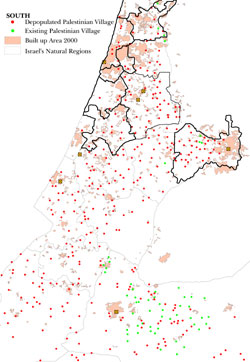
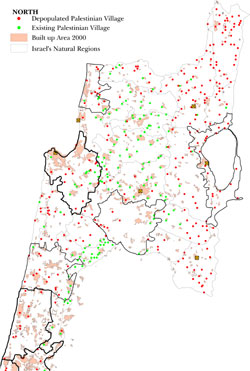
Another Israeli claim is that all village traces are lost and have been built over by housing for new immigrants. Again, even if this were true, it would not undermine the Right of Return: robbery of a property does not grant a title deed to the robber. However, the claim is false. We have enough records, maps, documents and registers, thanks to the British Mandate, sufficient to retrace every dunum. This information is available to Israel; on its basis it distributes Palestinian property to new immigrants. In Fig-10 and Fig-11, all the existing built-up areas in Israel today have been
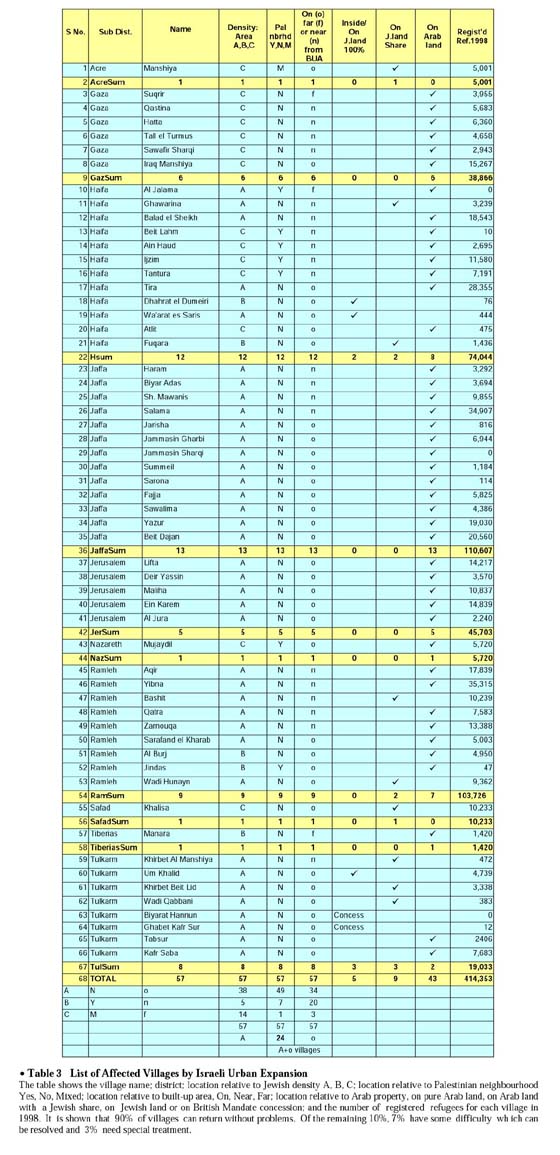
plotted. Superimposed on them are the sites of 531 towns and villages depopulated by the Israelis in 1948. The striking result is that the sites of the absolute majority of such villages are still vacant. All village sites, except one each in the sub districts of Safad, Acre, Tiberias and Nazareth, are vacant. Naturally, the area most affected is the coastal strip, especially in the Tel Aviv suburbs. There, a dozen village sites have been built over as a result of the expansion of the city. The displaced refugees from these built-over areas now number 110,000, or only 3 percent of all registered refugees. The largest depopulated villages are Salama, Yazur, and Beit Dajan, with a combined population of 75,000. A number of village sites west of Jerusalem, and north and south of Tel Aviv, have been also built over.
However, well over 90 percent of the village refugees could return to empty sites. Of the small number of affected village sites, 75 percent are located on land totally owned by Arabs and 25 percent on Palestinian land in which Jews have a share. Most affected villages are small. Only 27 percent of the villages affected by new Israeli construction have a present population of more than 10,000. The rest are much smaller. See Section-12.5 and Table-3 for futrher discussion.
The accommodation of the returning refugees from the affected villages is fairly simple, at least from an operational point of view: they could retain the property rights and grant a term lease to existing occupants, most of which are institutions. Meanwhile, they could rent or build housing for themselves in the vicinity. We are, however, left with the comfortable prospect that the overwhelming majority of the refugees would be able to return to currently empty sites. Their re-housing should not be an insurmountable problem, as will be shown in Section-12.6.
If a historical conflict is solved by the return of 5 million refugees to their homes in accordance with international law, what is the price of this huge achievement?
The 160,000 moshav and kibbutz residents who would be affected may decide to stay and rent land (this time from the owner, not from the ILA, by a simple change in the lease contract). Or they may decide to relocate.
The kibbutzniks have always been considered the pioneers of Zionism and the elite of Israeli society. A high proportion of army generals and Knesset members are kibbutzniks. They were usually granted the most fertile (Palestinian) land. However, this has dramatically changed. While 90 percent of Jewish immigrants joined a kibbutz in 1917, today only 3 percent of Israelis live on a kibbutz. There are constant desertions and very few new recruits. Most of the kibbutzim are near bankruptcy, with only 26 percent of them producing 75 percent of total kibbutz agricultural output.29
The area of irrigated fields cultivated by the kibbutzim decreased from 213,628 acres (acre = one fourth of a dunum) in 1987 to 189,564 acres in 1991.30 The economic return of these vast resources is meagre and diminishing, which put the kibbutz in debt. Out of $5 billion accumulated debt borne by the kibbutzim, the government has written off $2 billion, rescheduled $2 billion and encouraged the private sector to contribute $1 billion.
Following the Gulf War (1990-1991), a major change in government policy affecting kibbutz and moshav land further undermined the rights of the Palestinian owners. Until recently this land was officially held by the ILA and leased to the kibbutzim and moshavim. In the early 1990s Ariel Sharon, as Minister of Infrastructure, and Raphael Eitan, as Minister of Agriculture, introduced regulations permitting the rezoning of this agricultural land to residential construction to accommodate Russian immigrants and to build commercial outlets, shopping malls and private apartments. The kibbutzniks would then be compensated for this transaction at 51 percent of its value. This made the bankrupt farmers very rich overnight by allowing them to pocket the value of (Palestinian) land they never owned in the first place. This angered urban taxpayers, the vast majority of Israel’s population. Two committees, one in 1997 and another in 2000, reduced the compensation to 25 percent of the land value. Thus has “sacred spiritual property” been transformed into commercial real estate.
In 1997, ILA started to sell refugees’ land. The proceeds for such sales added to the coffers of the treasury about $1 billion a year, excluding compensation to the kibbutzniks. One dunum in the centre of the country sells for $1 million.31 In 1998, 110 kibbutzim were allowed to expand their residential area (that is, change the zoning from agricultural to residential), which can be sold to others, by 115 percent. “Others” may include any Jew living anywhere in the world. 150,000 residential units were planned in the kibbutz, out of a general plan for 500,000.
Sharon, who expropriated for himself a farm of several thousand dunums near Iraq Al Manshiya (Qiryat Gat), said:
“The only way to absorb the immigrants was by taking land from the kibbutz… I knew the (economic) hardship they are experiencing… it is better they build on the land and sell houses…”32
In June 2000, fifty-two members of the Knesset submitted a bill to rezone 4 million dunums, or 80 percent of the land registered with the UN Conciliation Commission on Palestine (UNCCP), from agricultural to residential land–in other words, to transfer the registration of Palestinian refugees’ land from land leased to the kibbutz to land sold to a developer in order to build and sell apartments to Israelis and Jews of any nationality.
ILA recently went further by selling plots by open tender for private construction in moshavim and kibbutzim directly without interference of those agricultural organizations. Deals are cut by direct contact with the lessee (so-called farmer) according to ILA fee scales.33 ILA and the ‘farmer’ receive the price of the sold Palestinian land, a land they do not own. The buyer has to sign a declaration that he will not sell or lease to non-Jews.
Now, the government of Israel is about to pronounce the death of the kibbutz, “closing a chapter of Zionist history”.34 The Kibbutz is to be dissolved, privatized or transformed into commercial real estate.
An interesting intervention was made by the impoverished Sephardic community, who did not share in the extravagant benefits showered on the kibbutzim. The Sephardim formed a group, Hakeshet Hamizrahit, which petitioned the High Court against sale of kibbutz land, stating that:
the land in question was largely expropriated from Palestinians and thus transferring property rights to the inhabitants of the rural communities means negating forever the Palestinian refugees’ right of return.35
Thus, the end of the historical conflict by the return of the refugees is sacrificed for the sake of a dying elite and a bankrupt movement, abandoned by the Israelis themselves.
Footnotes (↵ returns to text)
- Yair Aharoni, The Israeli Economy: Dreams and Realities ( London, 1991), pp. 200, 208-13, 134. ↵
- Eliezer Ben-Rafael, Crisis and Transformation: The Kibbutz at Century’s End (Albany, 1997), p. 240, Table-19 and p. 237, Table-10. ↵
- S. Abu Sitta, “The Great Israel Land Grab”, Jordan Times (Amman), March 2, 1998, p. 6; also Hanna Kim, “A Liquidation Sale of Public Lands”, Ha’aretz, June 20, 2000; Nehemia Strasler, “The Great Land Robbery”, Ha’aretz, July 21, 2000. ↵
- Meron Benvenisti, Sacred Landscape, p. 191. ↵
- Ziv Maor, “ILA plans to sell private lost on Moshavim and kibbutzim”, Ha’aretz, May 29,2001. ↵
- Ziv Maor, “Government may privatize Kibbutzim”, Ha’aretz, June 3, 2001. ↵
- Yair Sheleg, “The Big Sellout”, Ha’aretz, June 23, 2000. ↵
Water and Agriculture 36
Water can be a cause of war in the Middle East. It has been widely reported that Israel’s invasion of the West Bank and Syria in 1967 was designed to control the headwaters of the Jordan River and the tributaries and aquifers of the West Bank. Israel’s desire to maintain control of these water sources is one of the main reasons for its refusal to seal an agreement with Syria and the Palestinians. Each of these sources, in the West Bank and at the Syrian border, amounts to 500 million cubic meters per year (mm3/y), much of which is wasted, as will be demonstrated.
Water resources in the territory of Palestine on which the State of Israel was declared in 1948 are 350 mm3/y. This amount was increased, before 1967, by Israeli drilling under the West Bank and after the 1967 war, by full control of Palestinian and Syrian water sources. It reached 2,020 in 1990, of which 1,471 mm3/y is taken from sources located in Arab territory.37
Where does this water go? In 1995, 594 mm3/y went to municipal (domestic) purposes, 133 to industrial use and 1,300 to agricultural use. As Peter Beaumont has shown,38 municipal consumption works out to be a constant 100 m3/y/person for every year since the creation of the state in 1948. This is higher than the consumption of Jordan (60), and much higher than the impoverished West Bank (37.5), which has lost 90 percent of its water resources to Israel. And the overcrowded Gaza Strip has a critical water deficit with dangerously increased salinity.
Israel has maintained the use of 1,200-1,400 mm3/y for agriculture. The more extravagant use of 860 m3/dunum (1 hectare = 10 dunums) for irrigation in the 1950s has now been reduced to 600 m3/d. These precious resources are provided to the farmers at 70 percent of the cost at 19¢/m3, while the cost to domestic user is $1.0-$1.76/m3.39 Thus domestic users underwrite vast water subsidies to farmers, who raise water-intensive crops like potatoes, corn, cotton and watermelon.
Following the expulsion of the Palestinians and confiscation of their land in 1948, the amount of land under irrigation increased rapidly, from about 300,000 dunums in the early 1950s to 2 million dunums in the late 1970s, the difference between the two figures being Palestinian property. In the 1990s this figure shrank to 1.8 million dunums because of general lack of interest in agriculture. The total amount of land under cultivation has grown from about 1 million dunums in 1950 to 4.2 million dunums in 1997, shrinking from a maximum of 4.4 million dunums in 1990,40 the difference between 1 million dunums and the other figures being confiscated Palestinian property.
Startling news has been revealed recently showing that the irrigated land is in fact much smaller than officially stated. The State Comptroller41 has issued a report that 865,000 dunums stopped cultivation in 1988-1999, while still being allocated the same irrigation water! This means the ‘official’ irrigated area in Israel (1,943,000 d) is in reality only 1,078,000 d. or only 55% of the declared area!
Who utilizes this vast land? In 1998 there were 72,500 agricultural employees,42 of which 36,800 were Jews. Of those Jews, only 8,600 were kibbutzniks.
These vast land resources, with their generous water subsidies, account for only 1.8 percent of Israel’s GDP.43 To produce this meagre contribution, Israel has had to import 24,300 foreign workers (mostly from Thailand) while denying the right of the Palestinian farmers to till their own land. (Ironically, some of the Palestinian workers allowed in Israel actually work their own land, as hired labourers, for the benefit of Israelis.)
The waste in water has been noted by other authors. Some advocate reducing agricultural activity or changing it to more profitable crops, which would free water for other uses. One study notes that “the evidence strongly suggests that Israel’s water quantity crisis is more a result of misallocation than absolute scarcity”.44 Another recommends that the wasted water could be “sold” to Jordan and the West Bank in a peace deal. Apart from the irony that Israel would be selling illegally-confiscated water back to its rightful owners, the fact is that Israel’s enormous water and land resources are exploited by so few to produce so little. If this land and water were turned over to the lawful owners, there would be little loss to Israel-despite common claims to the contrary–and tremendous gain in the country’s political legitimacy, with a real chance for genuine peace in the region.
Professor Fadle Naqib, an expert on the Palestinian economy, formerly with the UN Conference on Trade and Development, says that although it is common for developing countries to reduce the agricultural share of their economy, it is necessary for Palestine to develop its agricultural sector.45 Capital requirements at this stage would be small, an ideal situation for a recovering economy. The vast majority of the refugees are farmers, and agriculture has been their occupation from time immemorial. When they recover their land, they will no doubt greatly enhance the value of the agricultural product. The refugees in Gaza already do so. With scarce and saline water, they produce better and cheaper vegetables than the neighbouring kibbutzim. That is why Israel refuses to admit their products to its market.46 I am not of course suggesting that all refugees should revert to agriculture or that agriculture is their only occupation. Palestinians are one of the most highly educated peoples in the Arab world, and have flourished in a number of skilled occupations. The point here is simply that Palestinians have a deep attachment to their land and will be able to cultivate it more economically than the Israelis. With their education, they will be able to meet the challenge of industrialized agriculture when this economic threshold is reached.
Another area of Palestinian excellence is Jaffa oranges, known for centuries. After the Israelis conquered Jaffa environs in 1948, “the overwhelming majority of the 150,000 dunums of citrus trees remained unattended… roughly one-fifth of the abandoned citrus groves in the whole country were still being cultivated”.47 The Israelis looted the pumps and pipelines and earmarked large tracts for housing construction. The remainder of citrus groves, which produced 950,000 tons in 1975, deteriorated to the extent that only 340,000 tons were produced in 1997 and 250,000 tons in the drought year of 1991.48 The famous Jaffa oranges could be revived by the Palestinian farmers who originally planted these citrus groves.
A more serious problem, however, will soon arise which may lead to a war bringing further destruction to the region.
Israel water requirements, now stand at 2,000 million cubic metres (mm3), two thirds of which are Arab, are barely met from the water resources at Israel’s disposal. Assuming the most modest increase in Jewish population and using the present rate of consumption, Israel would need 2,427 mm3 in the year 2020 [Fig-12] and 3,335 in the year 2050.
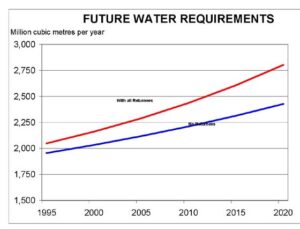
When all the refugees return and with less extravagant use of water (60 cubic metres per capita, instead of the present 100, there will be a requirement for 2,803 mcm, or a mere 15% increase.
The point is that any requirements over the present 2,000 will have to be obtained from elsewhere. The treatment of waste water will only defer the problem a little while. The desalination is very expensive, both as initial and running cost. It is barely successful in the Gulf where energy is cheap.49 Transportation of water from Turkey by sea requires reservoirs, now being built in Isdud and has health hazards associated with contamination.
With no refugees’ return, hence no peace, Israel may be tempted to attack Arab countries once again, seizing water resources in Lebanon, Syria and even Jordan. That will be the height of folly.
If, by the return of refugees, peace prevails, it is conceivable that regional agreements may be signed with neighbouring countries, including Iraq perhaps, so that water resources are shared based on justice and equity. It is also possible that water pipeline may be extended from Turkey or Iraq on Syrian soil. It is also possible that the energy required for desalination may be transmitted from the Gulf. Thus, the return of the refugees, a necessary prerequisite for the end of the conflict, may bring peace to the region and prevent war.
The well-known slick schemes proposed by Shimon Peres to bag all the benefits of the regional agreements without paying the price of justice and equity have all, not surprisingly, met their well-deserved demise.
To be sure, there are problems to solve. Many refugees would have to change their present occupation (now 25% in construction) and revert back to agriculture. Tighter controls on water consumption will have to be applied. At some cut-off point, say a maximum of 1,300 mm3/y, agriculture has to be industrialized. New and improved crops will have to be grown. In all this, Israeli research may be useful. Certainly the Palestinians would be enthusiastic workers, since they would be returning to their land cultivated by their forefathers for centuries. All in all, the return of peace and stability to the region far outweighs any application problems.
Footnotes (↵ returns to text)
- Much of this section is based on a paper to be published in a forthcoming book on Intifada. ↵
- S. Abu Sitta, in Palestinian Exodus, Karmi and Cotran, ed., p. 187. ↵
- Peter Beaumont, “Water for Peace in the Middle East: The Sacrifice of Irrigated Agriculture in Israel?” The Arab World Geographer, Vol. 3, No. 2, 2000, pp 97-112. ↵
- Nehemia Strasler, “Farms are the Water Wasters”, Ha’aretz, March 10, 2000. ↵
- Israel’s Statistical Abstracts No. 50 (1999), Table 13.1. ↵
- See Ha’aretz 30 April 2001: (1) Amiram Cohen, ‘Water Commission fails to check land usage’ and (2) Amiram Cohen, ‘Incompetent, Negligent, Lazy’. ↵
- Israel’s Statistical Abstracts No. 50 (1999), Table-13.8. ↵
- Central Intelligence Agency, The World Fact Book, 2000. ↵
- S.C. Lonegran and D.B. Brooks, Watershed: The Role of Fresh Water in the Israeli-Palestinian Conflict ( Ottawa, 1994), pp. 76-79. ↵
- Fadle Naqib, Palestinian Economy in West Bank and Gaza: Problems of Transition and Future Policies (Beirut, 1997, in Arabic), pp. 107-13. ↵
- For the effect of closure on agriculture and other aspects of the economy, see for example, the report of the UN Office of the Special Coordinator in the Occupied Territories (UNSCO) and the World Bank, “Closure on the West Bank and Gaza”, at www.arts.mcgill.ca/MEPP/unsco/unfront.html. ↵
- Meron Benvenisti, Sacred Landscape, pp. 164-65. ↵
- Cited by Beaumont, above, p. 105. ↵
- See Dabbagh et al., “Desalination an Emergent Option” in Peter Rogers and Peter Lydon (eds.), Water in the Arab World: Perspectives and Prognoses (Harvard University Press, 1994), p. 228, Tables 3 and 4. ↵
Considering the European Jews’ history of oppression, Jewish fear of gentiles is understandable. But when this fear is forged into active policy, it is dangerous and bloody, as the case has been in Palestine. The expulsion of the Palestinians and expropriation of their property, as a precondition for establishing the state of Israel, was a result of this paranoia. That was Ben-Gurion’s doctrine, now fully documented by historians. This doctrine is still being followed. It calls for committing an actual murder for fear that the victim, if he lived, might harm the murderer.
The claim that the “Jewish character” of Israel would be threatened is commonly recited to justify the denial of the fundamental right of Palestinians to their land and property. But what is the meaning of “Jewish character”? Does it mean legal character, demograhpic, social or religious? If it entails policies that deny the return of refugees and allow unlimited numbers of Jewish immigrants in their place, these policies are best described by the noted jurists Thomas and Sally Mallison, who pointed out that “the term, ‘the Jewish character’, is really a euphemism for the Zionist discriminatory statutes of the State of Israel which violate the human rights provisions of the Partition Resolution… The United Nations is under no more of a legal obligation to maintain Zionism in Israel than it is to maintain apartheid in the Republic of South Africa”.50 The US State Department rejected any special meaning for the Jewish citizens of Israel by stating that it “does not recognize the legal-political relationship based on the religious identification of American citizens… Accordingly it should be clear that the Department of State does not regard the ‘Jewish people’ concept as a concept of international law”.51
This is not an isolated view. In 1998 the UN Treaty-based Committee on Economic, Social and Cultural Rights said that Israel’s “excessive emphasis upon the State as a ‘Jewish State’ encourages discrimination and accords a second-class status to its non-Jewish citizens… The Committee notes with grave concern that the Status Law of 1952 authorizes the World Zionist Organization/Jewish Agency and its subsidiaries including the Jewish National Fund to control most of the land in Israel, since these institutions are chartered to benefit Jews exclusively… The Committee takes the view that large-scale and systematic confiscation of Palestinian land and property by the State and transfer of that property to these agencies constitute an institutionalized form of discrimination because these agencies by definition would deny the use of these properties by non-Jews.”52 Israel cannot maintain this position for long. The moral and legal weight of human rights will catch up with it one day. How can this concept of “Jewish character” be an acceptable basis for peaceful relations?
Some Israelis understand the “Jewish character” as a society in which Jews are a numerical majority. But in what territory? In the whole of British Mandatory Palestine? Today, 47 percent of the population of Palestine are (non-Jewish) Arabs and 53 percent Jews. In fact, the percentage would be reversed if we take account of the fact that 62 percent of the Russian immigrants are not really Jews.
Let us examine this matter further. Israel’s Master Plan for the year 2020 made a detailed study of population increase in Israel with various scenarios for Jewish immigration.53 The standard case gives a population of 8,100,000, of which 5,832,000 are Jews and 2,268 (40% of Jews) are Palestinians, in the years 2020. In the same year, Palestinian refugees will increase to 11 million.
The Jews in the world are about 13 million and decreasing at a rate of -0.50% due to mixed marriages and conversion or abandonment of religion. That is because 98% of Jews live in affluent societies and have no need for protectionist measures leading to isolation. Israel plans to have 52% of the world Jewry, or more, in Israel by the year 2020.
Sharon’s aggressive plans call for removing the remainder of Russian, all South American and South African Jews from their countries to Israel. Jews in Europe and USA have no interest to immigrate save for the zealots who now build settlements and terrorize the West Bank.
Taking the most and least optimistic forecasts of Jewish immigration (1,700,000 and 800,000 respectively), it becomes apparent that there is an upper limit for immigration which may be reached before 2020 [Fig-13]. Showing the Palestinian
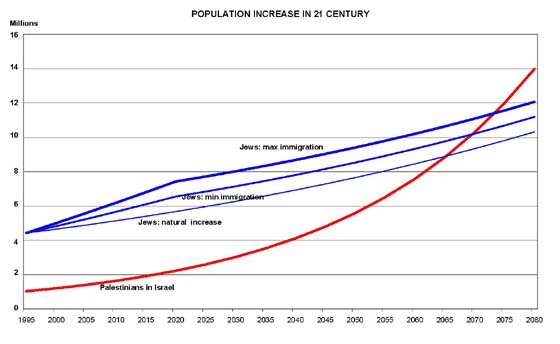
Taking the most and least optimistic forecasts of Jewish immigration (1,700,000 and 800,000 respectively), it becomes apparent that there is an upper limit for immigration which may be reached before 2020 [Fig-13]. Showing the Palestinian
increase in Israel on the same curve, it is clear that they will overtake the Jews in or around the year 2070 with or without immigration. That is assuming that no other factor comes into play before then. By 2070, the total number of refugees will be equal to the size of Egypt today at 61 million.
The folly of numerical superiority of Jews at all times in all of Israel or all of Palestine is very evident. [In a desperate attempt, leading defence figures and academics mentally barricaded themselves in the Interdisciplinary Centre, Herzliya discussing “The Balance of National Strength and Security in Israel”.55 These, otherwise rational academics put forward proposals to overcome the ‘Arab Peril’ which have no honest name other ethnic cleansing or apartheid. They advocated cutting government aid to the two million in Israel who are seen as a burden (Arabs and Haredim) and directing all support to the elite Ashkenazi. Arabs would be denied family benefits or ethnically cleansed through a contrived exchange of population formula. Meanwhile Jews are to be encouraged to live in Arab or empty areas in Israel. Arabs may be deprived from voting and Israelis living abroad be given the right to vote. It is only another step to declare all Jews Israeli citizens. An Australian Jew can then vote on whether an Arab village in Galilee should have water or a school.
This desperation would at best buy some time; meanwhile it will prolong the suffering and build a legacy of injustice and desire for revenge.
The fallacy of Israeli arguments, aiming to maintain Jewish majority, is abundantly clear. They aim to attain an impossible goal: that Jews will remain a majority at all times in all territories held by Israel. This is impossible. Either the time within which this majority can be maintained shrinks or the territory in which this can be maintained shrinks. A better solution for Jews, indeed for all people, is to live with the people of the land, not instead of them.
All these examples indicate that the notion of the numerical superiority of Jews is a cruel time game in which the refugees rot in their camps until the Israelis realize, or admit, that this contention is a horrible hoax, intended to keep the conquered land empty until its owners give up or are gotten rid of by a “final solution” of the Palestinian problem.
The most incredible notion is the claim that the “Jewish character” means a socially homogeneous society in which Jews speak one language, dress and behave similarly, and uphold the same values, such that the presence of one national group as the Palestinians will ‘pollute’ this uniformity. It is hard to imagine that very many Israelis really believe this. There are no dominant common features between the Russians and Moroccans, the Mizrahi and Ashkenazi or the Haredim and the secular. There are thirty-two official spoken languages in Israel and about two dozen political groups with an equivalent number of newspapers for a Jewish population a little larger than Los Angeles. The problem of their fractured society is a serious one, and it is already causing internal conflict in Israel, now tenuously held together by the drummed-up Arab danger. Considerable research has already been devoted to this question.56 But the return of Palestinians to their ancestral homes would not substantially exacerbate these problems. Already, the Palestinian citizens of Israel [Fig-9] are 11 percent of the population in group-A, 21 percent in group-B and 70 percent in group-C.
If the “Jewish character” refers to religious practice, this has rarely been a problem in the Arab and Islamic world. Numerous historians have demonstrated that the treatment of Jewish minorities by Islamic and Arab societies has been far better than that by Christian societies.
There is no ethical or legal justification for the maintenance of a “Jewish character” that denies human rights or violates international law. The real reason for Israel’s racist practices is to maintain its hold on Palestinian land and keep it as a reserve for future Jewish immigration. On March 1, 2001, the Israeli media reported that Prime Minister-elect Ariel Sharon told the Jewish Agency that his plan is to bring 1 million immigrants from Russia, Mexico and Ethiopia, and that Israel must bring all of the world’s Jews to Israel by 2020.
Footnotes (↵ returns to text)
- W. Thomas Mallison and Sally V. Mallison, “The Right of Return”, Journal of Palestine Studies, Vol. 9, No. 125, Spring 1980, pp 125-136. ↵
- Letter from Assistant Secretary of State Talbot to Dr. Elmer Berger, American Council for Judaism, April 20, 1964, in 8 Whiteman Digest of International Law 35 (1967). Cited by W.T. Mallison, “The Legal Problems Concerning the Judicial Status and Political Activities of the Zionist Organization/Jewish Agency”, Institute for Palestine Studies, Monograph No. 14, Beirut 1968. ↵
- “Concluding Observations of the Committee on Economic, Social and Cultural Rights”, December 4, 1998, E/C.12/1/Add.27. See the www.unchr.ch website. ↵
- Adam Mazor, ed. “Israel Master Plan 2020”, Vol. 6, ‘Israel and the Jewish People’, Table 4, 10, Haifa, 1997. ↵
- “UN Report: Palestinians in Israel Will Outnumber Israelis in 2050”, Jerusalem Post, March 1, 2001. The full report may be found at view pdf. ↵
- See footnote 70. ↵
- There is a growing body of literature on the nonhomogeneous and fractured Israeli society. See, for example, Akiva Orr, Israel: Politics, Myths and Identity Crises (London, 1994), and A. Cohen and B. Susser, Israel and the Politics of Jewish Identity (Baltimore and London, 2000). ↵
It is now possible to put forward the main elements of the refugees’ return plan.
1-Locating the Refugees
The Palestinian people are a very closely-knit family. Geographical dispersion in exile did not destroy the essential fabric of the society. They still marry within their own social circles, as they were in 1948-Palestine, although travel and residence in foreign countries have eroded this practice only marginally. This however has a positive effect as the foreign spouses have been drawn into the Palestinian circle. In general, there does not seem to be a serious problem in locating and identifying Palestinian families.
This family bond is important, especially for the Palestinian refugees who were not registered by UNRWA in 1950 or any time thereafter. The unregistered refugees are essentially the inhabitants of Palestinian cities who either left early in 1948, did not have a material need for assistance, which was the object of registration, or others who, while needy, did not register out of pride, prior to closing down of the registration process, or who missed the registration for one reason or another.
Careful estimates show57 that all refugees from 531 depopulated towns and villages by Israeli forces in 1948 are 4,940,000 as at the end of 1998, fifty years after al Nakba of 1948. Of those, 3,602,000 are registered with UNRWA.
Total refugees may be divided as follows [Fig-14]: 56% are registered refugees.
from villages; they have the highest percentage of registration and they lost all livelihood by losing their homes, farms and cattle. Therefore it is not surprising that only 6% of villagers are unregistered. The total is 62% or about two-thirds of all refugees representing rural areas. The remaining 38% are urban population. More than half of those (21%) are unregistered, leaving 17% registered. If we take the registered refugees only, we find that 23% are urban and 77% are rural, showing again that the majority of rural refugees are registered.
It should be noted that refugees were expelled, not only from 531 towns and primary villages, but also from 662 secondary villages,58 such as hamlets, satellites or small settlements.
There is no record of any Arab people in the Middle East as detailed and monitored over 50 years as that of the Palestinian refugees. At the time of registration, refugees had to show proof of residence in Palestine, e.g. Kushan (property title deed), passport, identity card, tax receipt, school certificate, government employment record… etc.
There are now over 700,000 family files and about 4 million individual files held by UNRWA. The following is listed: full name (including father, grandfather and family), sex, date of birth, place of origin (depopulated village), district, rank and relationship within the family (48 categories), number of family members and place of refuge. The latter is divided into 5 areas in which UNRWA operates: Gaza Strip, West Bank, Jordan, Syria and Lebanon. In turn, these areas are divided into regions and those into distribution centres. Every refugee has a unique number. It is possible to mobilize the people of any given village in a week.
Indeed, when the inhabitants of a village were expelled by the Israelis in 1948, they left en masse. Fully 72% of all the registered refugees moved to only one of the 5 UNRWA areas and 20% moved to two related areas of the five and only 8% moved to more than three areas.59
Thus locating the refugees poses no problem.
2- Locating the Refugees’ Land
The British Mandatory government in Palestine (1920-1948) documented the country in a series of detailed maps. This has served to preserve the Palestinian property rights, although the intention of the pro-Zionist government was the opposite, to facilitate Jewish immigration and settlement in Palestine by transferring to Jews as much land as possible.
In spite of persistent efforts, the Zionists did not have under their possession in 1948 more than 1,682,000 dunums or 6% of Palestine. This figure, which is the upper limit of land under Jewish possession, consists of:60
| Full Possession | 1,449,958 dunums |
| Undivided share in a Common | 56,628 dunums |
| British Concessions | 175,000 dunums |
Not all the land under ‘full possession’ above was legally registered in the Land Registry. A considerable portion of this land was held or cultivated by the Jews on the basis of interim agreements, promises to sell, doubtful claims or in contravention with the Mandate Land Regulations. The fortnightly reports of the District Commissioners are replete with examples of fraud, unfounded or illegal claims. In Beer Sheba District, for example, the areas claimed by the Jews and included in the above summary are greatly exaggerated as evidenced by the District Commissioner’s report.61
Much land is cultivated in Palestine as common village land (Musha’) which cannot be divided by shareholders, who are traditionally family members. When the Jews bought the share of one family member, they could not identify or split this share physically, much the same like a share on the stock exchange. Thus the Jewish ownership of undivided land remains an economic, not a physical, proposition.
The pro-Zionist Mandate government granted concessions to the Jewish colonists which had a given purpose and a maturity date, after which the land reverts back to the people of the land at the time. All concessions expired in 1948, when the British Mandate was dissolved on 15 May 1948.62
Thus the figure for Jewish property in Palestine, small as it is, represents the upper limit of Jewish possession. Further, legal Jewish purchases are well documented as the great majority of such land was owned by colonial enterprises, not individuals, who kept records of transactions and ownership.
Be that as it may, it is clear that the remainder of Palestine is (non-Jewish) Palestinian property for countless generations. Palestinians should not be required to prove evidence, much as any region in England does not require proof of being British. The onus of proof of ownership lies with the foreign immigrants who wanted to secure a foothold in the country.
The UN, in its well-known resolution 194, formed the Conciliation Commission of Palestine (CCP). One of the lasting benefits of CCP is the documentation of Palestinian property in Palestine from the Mandate records and in consultation with Israel, Jordan and other Arab countries.
CCP recorded the ownership of about 500,000 Palestinian landowners, whose ownership covers an area of 5,194,091 dunums,63 classified under each of the administrative boundaries of towns and villages. The survey covered 797,504 parcels of land, which are well-defined on maps. Although these records are extremely valuable, they do not cover the whole extent of Arab Palestine. This deficiency is clearly seen by comparing the official area of each district with the total ownership (Jewish and Palestinian) of all lands in the district. Considerable deficiency of ownership according to CCP records is found in the sub-districts of Gaza, Hebron, Jaffa, Jenin, Jerusalem, Ramle and Tulkarm. CCP admits lack of information in Ramle sub district and in Jerusalem villages. More significantly, CCP omitted the entire Beer Sheba sub-district (12,577,000 d.) due to ‘lack of information’.
With the detailed British maps and the Land Registry records, and by subtracting authentic Jewish ownership records from the area of Palestine, the property of the Palestinian refugees is determined. Individual owners in each village/town are determined from CCP records. Village land is determined from administrative maps of Palestine which define the village boundary and area (according to Village Statistics of 1945). The village inhabitants are determined from UNRWA records. Thus the village land area, location and boundary, together with the names, number and present place of refuge of its owners (usually limited to 3-4 hamulas or extended families) are all satisfactorily determined.
3-Transfer of Ownership
The fictitious legal web created by Israel (see Section-4 above) has the unexpected advantage of making it easier for the Palestinians to restore the ownership of their property. All their land is administered by Israel Land Administration (ILA) which disposes of their property. No Jew holds a legal title deed to a Palestinian property. There will be no possibility of a multitude of legal disputes among Palestinian and Jewish individuals.
A simple way to deal with this situation is to transfer all legal jurisdiction from ILA to the proposed Palestine Land Commission (PLC). PLC will be created as an independent body to represent, defend and preserve material property rights of the Palestinians. Its members are representatives of 531 depopulated and dispossessed Palestinian towns and villages. As indicated earlier, the family unit in Palestine is very strong. Hence the village unit (and neighbourhoods in towns) can be regarded as stable building blocs of Palestinian society.
PLC will be the custodian for all property until individual owners are identified and verified. PLC will hold and acquire the property of those few who wish to dispose of it.
This system has many advantages. There will be a single transfer document form ILA to PLC. The records of ILA in its central and district offices contain electronic information of all Palestinian property in addition to maps showing parcels’ locations (with their British and new Israeli numbers) which are largely digitized with proper geographical coordinates under GIS.
The ownership of each village is well-defined in area and location in British maps. While the population of each village has increased more than 5 times in the last 50 years, the ownership of each family remains intact. Any dispute over ownership will remain essentially a family business.
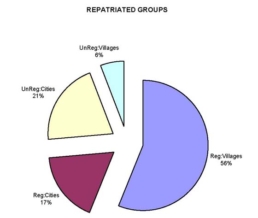
Thus a smooth transfer is possible. Problems or disputes which may inevitably arise are transferred to PLC and, in turn, to village families.
4-Phases of Return
Due to the nature of repatriated groups, it is possible to split repatriation into 7 phases, each with a population varying between 0.5 and 1.0 million. See [Table-1].
Some phases could be concurrent. The whole process could take less than 10 years. These phases are:
4.1-Return of Refugees from Syria and Lebanon. (Fig-15)
Their rounded-off number is 500,000, which represents the registered villagers from the districts of Haifa, Acre, Tiberias, Safad and Nazareth–excluding cities. All these refugees can return safely to their vacant village sites. There are only few affected villages (Table-1), where their village sites have been partially or fully built-over, as they are situated in the Area-A, which has the highest Jewish concentration. There are only two such villages, which are both in Area-A and fully built-over. These are: Tira, Wa’arat es Saris in Haifa district.
In general, these refugees will return to a friendly environment. They will be reunited with their long-separated kith and kin in Galilee, which is still largely Palestinian today.
4.2-Return of Refugees from Gaza Strip. (Fig-16)
Gaza Strip is the most crowded (about 6,000 persons/sq. km) and economically impoverished place; that is where the refugees from southern Palestine are crammed. Across the barbed wire, they can see their fields empty (at only 6 persons/sq. km). The rounded-off number of the registered refugees from villages in Beer Sheba, Gaza, Ramle and Jaffa districts is 686,000. The return to Beer Sheba and Gaza districts is straightforward, as their land is almost empty. As Table-1 shows, Qiryat Gat has expanded to cover the location of Iraq Al Manshiya houses, but the village land is still available. (The US Computer Company, Intel, has illegally built a plant on the location of the village houses).
Ramle refugees can return to their villages in the district, which is situated in Areas A, B, and C. Higher Jewish density in Area-A causes 2 villages to be affected: Aqir and Wadi Hunayn, and in Area-B 3 villages are affected: Sarafand al Kharab, Al Burj, Jindas. Jaffa villages need a special treatment.
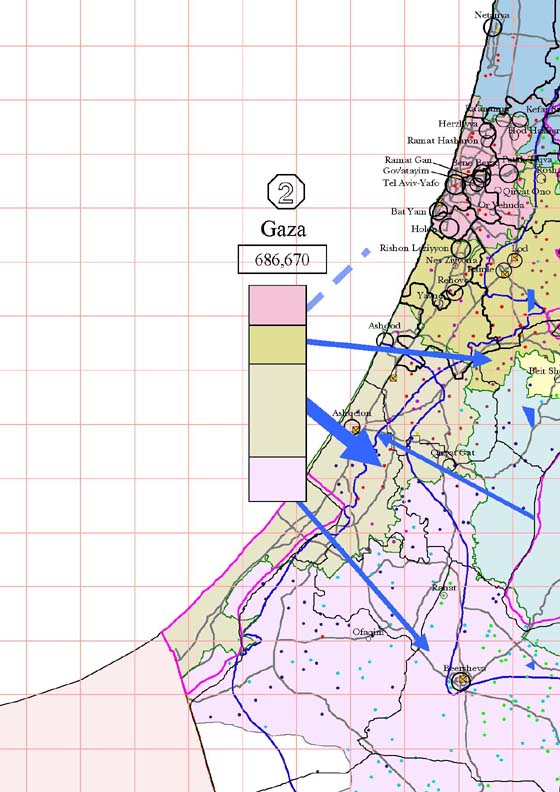
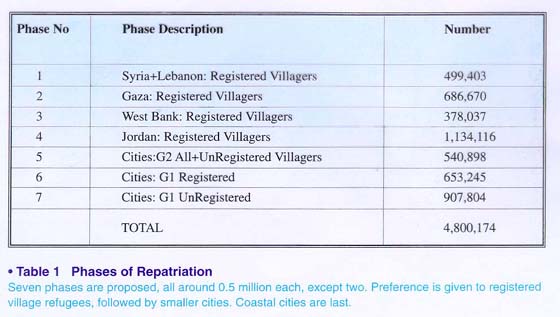
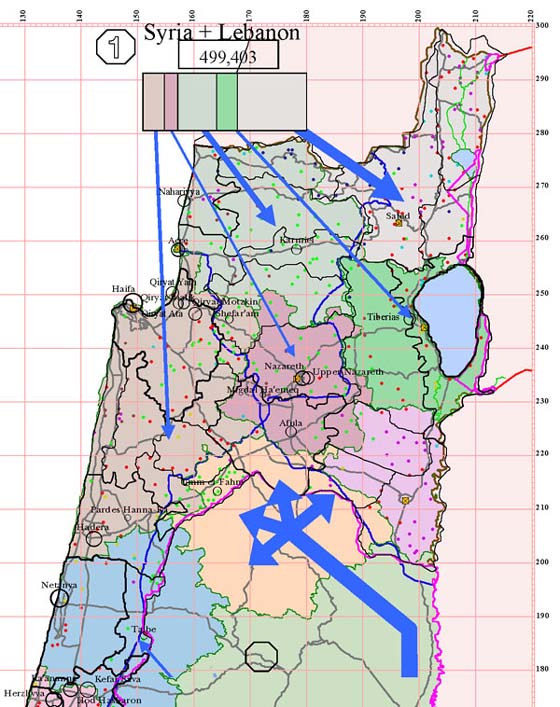
The rounded-off number of registered village refugees now living in the West Bank is 378,000. Their original homes are diverse (9 districts). They come from nearby Jenin, Jerusalem, Tulkarm and Hebron districts, from Gaza and Beer Sheba districts in the south, from Jaffa and Ramle districts in the centre, and from Haifa in the north. The number of refugees from each district is relatively small, ranging from a maximum of 71,000 from Jerusalem district down to 14,000 and 16,000 from Beer Sheba and Gaza districts respectively.2
As indicated above, there is no problem in returning to vacant village sites in Gaza, Beer Sheba districts. Also, there is no problem in returning to Jerusalem district except for 5 villages: Lifta, Deir Yassin, Maliha, Ein Karem and al Jura, which are incorporated in greater Jerusalem. The subject of Jerusalem city deserves a special treatment which is excluded from this study.
Return to Haifa district is already covered in Section-12.4.1. Return to Jenin district poses no problem but Tulkarm district does. Eight villages fall within the coastal strip, which is densely populated by Jews and many of their sites are over-built. These are: Um Khalid (Netanya extended over its land), Khirbet Beit Lid, Wadi Qabbani, Biyarat Hanun, Ghabet Kafr Sur, Tabsur, Kafr Saba (next to Kefar Sava) and Khirbet al Manshiya. These are small villages. Their total present (1998) population is 19,000. Treatment of all such affected villages shall follow.
4.4-Return of Registered Village Refugees from Jordan [Fig-17]
This group is by far the largest, at 1,134,000. Their composition is similar to refugees in the West Bank with the addition of 3 new districts: Tiberias, Beisan (close to river Jordan) and Nazareth. The reason for their large number and the relatively small number of refugees in the West Bank is due to the 1967 war. Today the number of displaced persons as a result of the 1967 war is estimated to be 800,000 persons, who were expelled or forced to leave Palestine to Jordan. (The figure of 800,000 includes refugees and citizens of the West Bank64).
The feasibility of their return is similar to those of the West Bank (12.4.3). The village sites in the new districts: Tiberias, Beisan and Nazareth are all vacant. However, a hamlet, al Manara, is built over by the expansion of Tiberias city. Nazareth district and part of Tiberias and Beisan districts are today inhabited by a sizeable Palestinian population.
4.5-Cities:
The previous phases refer to the registered refugees from villages only. The great majority of village sites are still vacant. Many of the village houses were destroyed by the Israelis. According to a field survey in 1987-1990,65 out of 407 villages surveyed, 81 villages were completely obliterated, 140 destroyed but rubble identified, 60 demolished with standing walls, 74 most houses demolished but some remain standing, 17 villages with many houses demolished and where 1-2 Jewish families live and 35 villages with houses standing where more than 2 Jewish families live.
The situation in the cities is different. No large scale demolition took place, but the remaining Palestinian inhabitants were not allowed to repair their houses, even to fix a glass pane, or to add an extra family room. Houses of evicted Palestinians were occupied by Jewish immigrants who were allowed to make all desired alterations.
In all, the Israelis conquered 14 Palestinian cities [Table-3]. These may be grouped.
as follows: 2 cities: Nazareth and Shafa Amr are still Palestinian. The return of the refugees there will not represent a problem. Six cities were entirely Palestinian: Safad, Tiberias, Beisan, Beer Sheba, Al Majdal (Ashqelon) and Isdud, except that Safad and Tiberias had a small old-time Jewish religious community. Those six cities (termed thereafter Group-2, G2) are now inhabited entirely by Jews, a clear case of ethnic cleansing. In the following phases we shall examine the possibilities of return to these cities.
The remaining 6 cities, (termed thereafter Group-1, G1) have special characteristics. Many of them are coastal; all have had always mixed Jewish and Palestinian population with the difference that, before 1948, Palestinians were a majority, now Jews are the majority. These are: Acre, Haifa, Jaffa, Lydda, Ramle and Jerusalem. Of all the 14 cities, there should be no insurmountable problem in the return of refugees to their homes, except for two: Jaffa, which lies in the middle of Jewish concentration in Palestine and Jerusalem, not so located but has a highly sensitive political and religious significance.
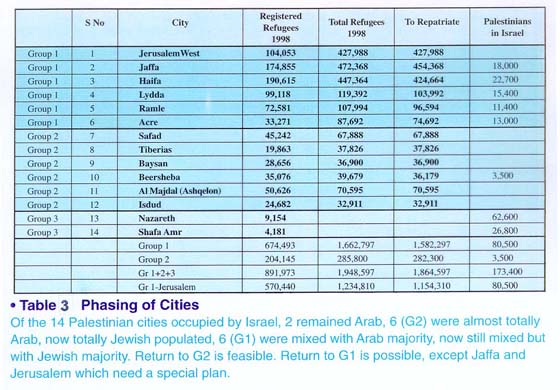
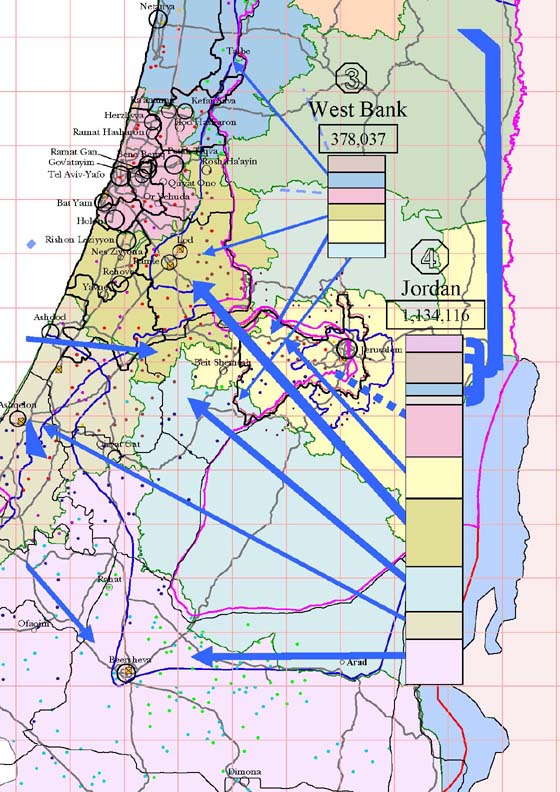
4.6-The Return of Registered and Unregistered City Refugees (Group-2)
The number of registered city refugees in Safad, Tiberias, Beisan, Beer Sheba, Majdal and Isdud is about 182,000. Here, those unregistered are much smaller than the case for larger cities. Their number is 78,000. For the sake of completeness, we add to this phase the unregistered village refugees, who did not, or were unable to register for reasons cited. Their number is 280,000; they pose no problem as they all come from empty or vacant sites. Thus the total number of refugees for this phase is 540,000.
It is now necessary to examine the town plan of each city. This is done using (1) British Mandate town planning maps showing the built-up areas, town planning urban limit and the town’s rural land and (2) the built-up area of the city according to modern Israeli maps (year 1998) showing the extent of the present urban area. In order to compare 1948 and 1998 areas, Palestinian town’s area of 1948 is expanded, in the space available now, to reflect the present Palestinian population had they not been evicted. This is shown (in purple) in all diagrams of cities, together with 1948 (Palestinian) and 1998 (Israeli) urban limits.
The results are shown in [Figs-18, 19, 20, 21, 22, 23] In all cases, it is shown
that Palestinians can return to their cities and can build new homes, for the increased population, in the city land without necessarily evicting the present Jewish occupants as done by Israel to the Palestinians in 1948.
In Safad, the city can expand to the north and east to accommodate the returnees. In Tiberias, the expansion can take place along the shoreline of the lake. In Beisan, there is plenty of space for expansion in all directions except the south. Beer Sheba has expanded greatly, mostly to the north, leaving east and west and possibly the south for new expansion to accommodate the returning home owners.
Isdud does not present a problem at all. The city can expand around its original position, which was a large village. The new Israeli Isdud (Ashdod) is built elsewhere, on the shoreline where a large port is built.
Al Majdal can expand in all directions except the south. Again the new Majdal (Ashqelon) is built on the shoreline.
It is significant to note that all of the six cities are now inhabited by non-Ashkenazi Jews. As such, they do not benefit from the favours showered on the Ashkenazi ruling elite. They suffer from discrimination and are economically impoverished, but less so for Isdud due to the port activity and Beer Sheba where the university provides large employment.
With the dismantling of Israel’s racist policies, and the removal of Zionist incitement to Arab hatred, it is possible for the Palestinian returnees to live in harmony with the present Jewish inhabitants who are mostly Mizrahi, that is Jews from Arab and Islamic countries.
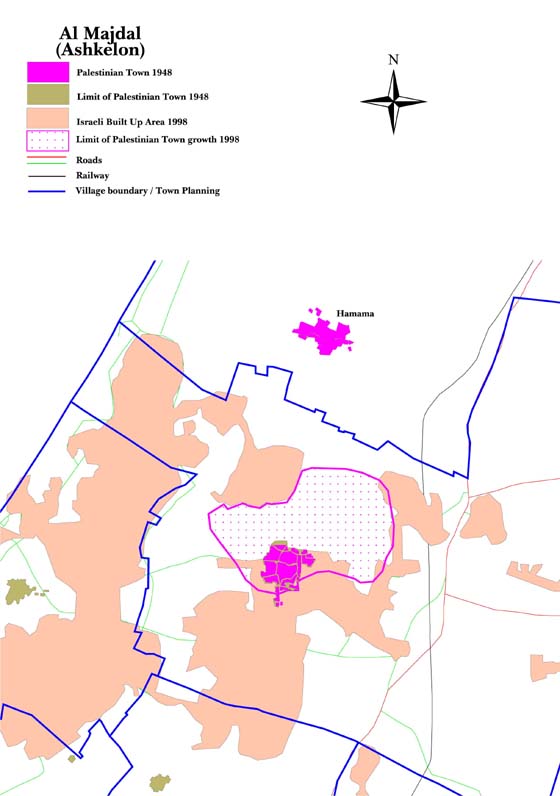
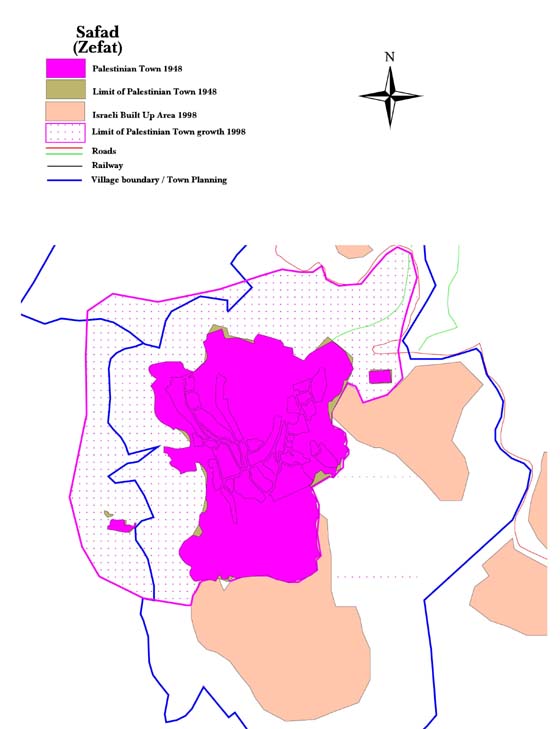
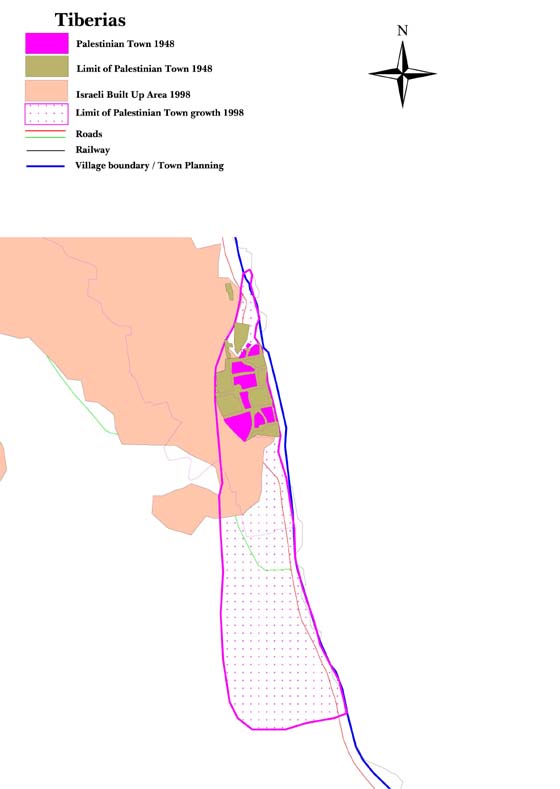
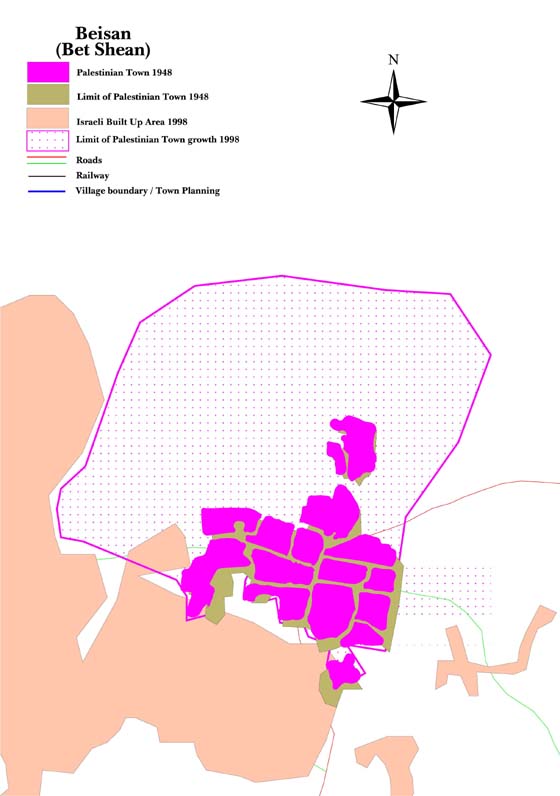
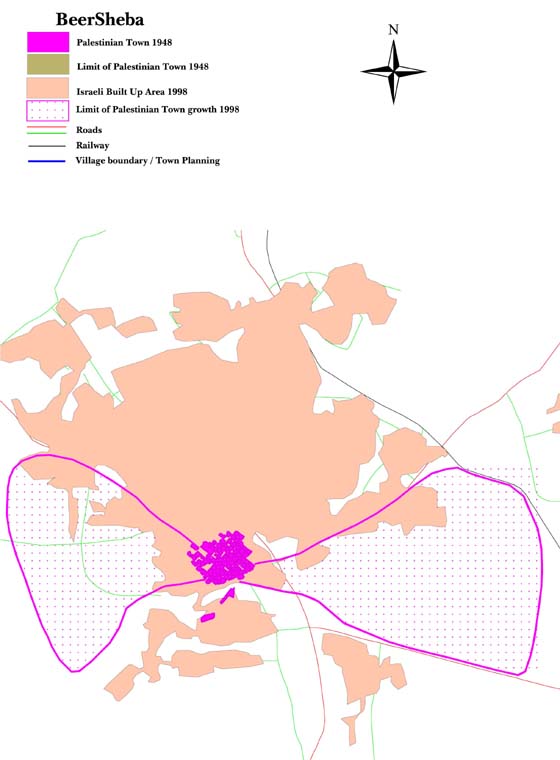
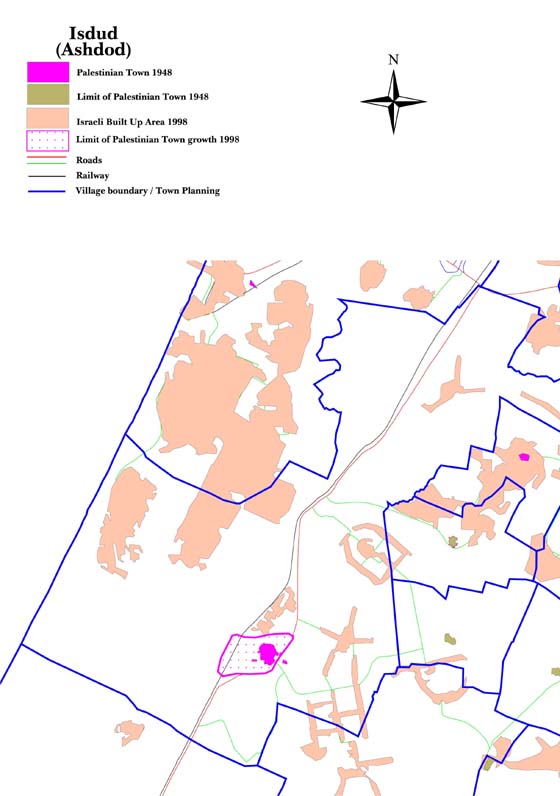
Acre and Haifa [Fig-24, 25] are known to enjoy relatively peaceful coexistence.
between Palestinians and Jews. The Palestinians still live in the Old City of Acre and the returnees can expand this city along the shoreline, still within Acre lands. Haifa’s Palestinian population are an active element in the society. They still live in large concentrations in old Haifa particularly Wadi Nisnass, Abbas, Carmel and old city. But metropolitan Haifa has still large vacant spaces to the south and east, sufficient to accommodate the new comers.
Lydda and Ramle, which were once a proud, rich and vibrant twin, have now been reduced to a lamentable state of decay. The decay is both urban, out of neglect and biased administration, and moral; they are the centre of drug trade. Palestinians there suffer from economic deprivation and social incohesion. New Jewish immigrants are sent there; they desert the place as soon as they know the country better. It is to them a ma’abarot, a transit centre.
With the return of the original homeowners, they can bring back lustre and dynamism to these cities, especially with the return of well-known merchant families, writers and artists back to their cities.
As [Fig-26] shows, the amalgamation of the twin cities is inevitable. The expansion of the two cities to accommodate the returnees is quite possible. In addition to their famed agriculture, their location, astride railway and road junctions, will bring affluence to the now decaying cities by virtue of the energies of its returning merchants.
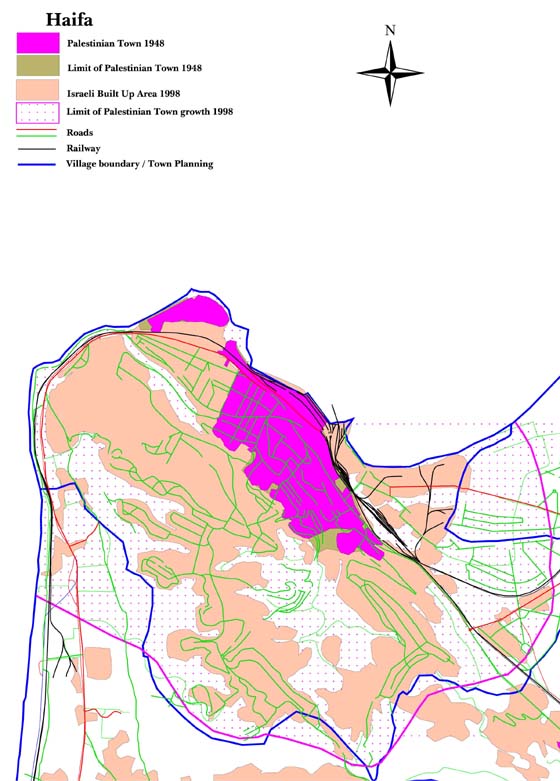
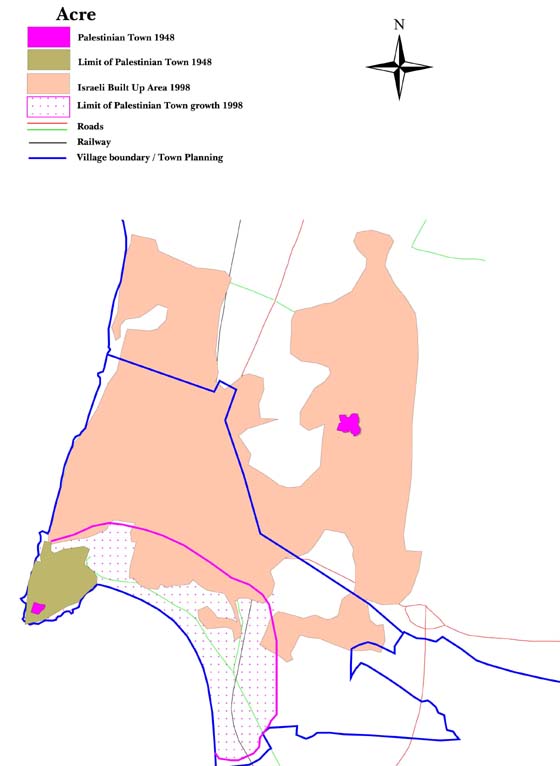
The return to Jaffa [Fig-27] is a difficult but not unsolvable problem. The reason is..
4.8-The Return of Unregistered City Refugees (Group-1)
This last phase of repatriation involves 900,000 unregistered refugees from the six major Palestinian cities. Today they hold important financial and governmental positions in Amman, Beirut, the Gulf, London and Washington. They are the most mobile, affluent and sophisticated segment of the society, but unlike 1948, their political influence in Palestinian affairs today is minimal.
Their return, in terms of housing, would pose the same problems as that of the registered refugees, although they possess much more property. The size of their holdings, together with their business experience and contacts will add vitality to the economic life of the cities.
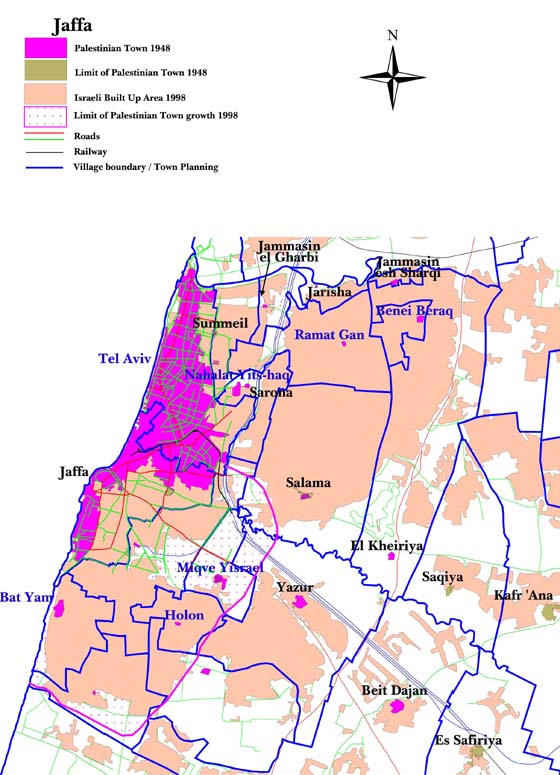
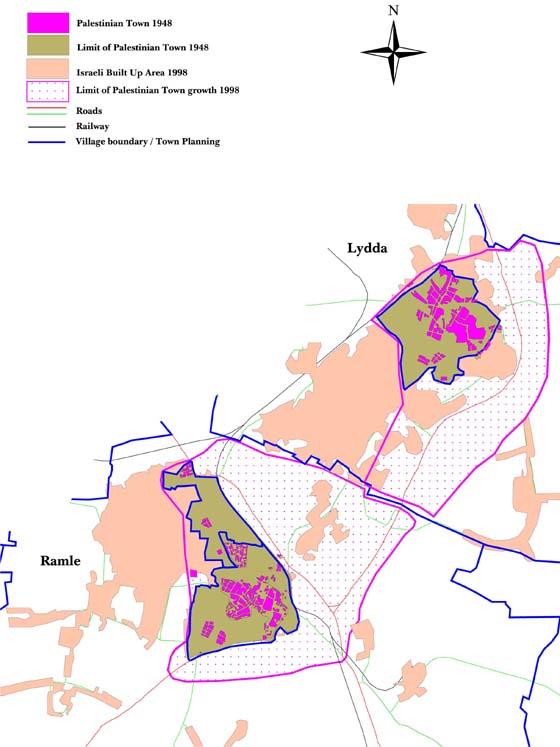
5-The Restitution of Village and City Property
It has been shown that most of the village sites are vacant and the refugees could return to their homes without difficulty. As [Table-3] shows, only 57 villages, out of
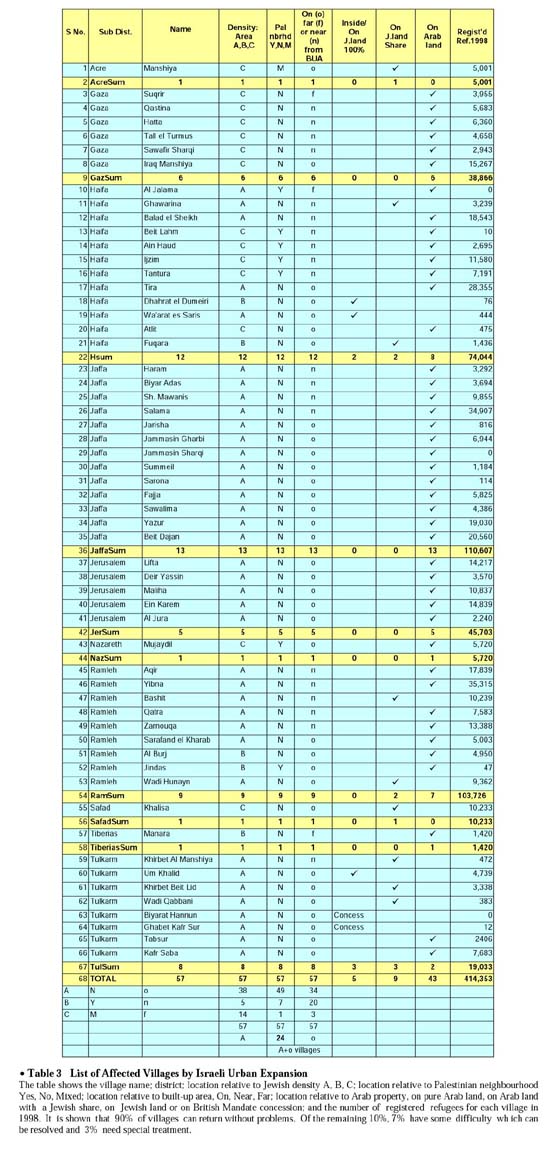
531 towns and villages are affected in a way or another, by the encroachment of Jewish urban expansion. The present exiled population of these villages is 414,000, or about 10% of all registered refugees. This means that fully 90% of the refuges can return home without difficulty.
The picture is even brighter than this. It is considered that the problem area is related to villages (1) which falls in Area A, with high Jewish density and (2) where its site is fully built-over. This applies only to 24 villages, 5% of all villages. Their present population is 160,000, or 4% of registered refugees (3% of all refugees), which is a tiny minority.
The largest number of highly affected villages lies naturally in the coastal strip where there is highest Jewish concentration in and around Tel Aviv. This includes villages such as Salama, Sarona, Summeil (Mas’udiya), Jarisha, Jammasin Gharbi and Sharqi, Yazur, Beit Dajan and Sheikh Muannis on which Tel Aviv university is built.
Affected villages near West Jerusalem are Lifta, Deir Yassin, al Jura and Maliha (on whose land the notorious Gilo settlement is built).
All Jewish-occupied Palestinian property in all cities can be dealt with smoothly.
For all these cases: the affected villages and cities, the ownership is transferred first from ILA to PLC, then it is handed over by PLC to eligible and qualified property-owners. Those owners then extend the existing lease of the Jewish occupant, if he wishes so, to a period depending on the owner’s family requirements but not less than 3 years. The owner may elect meanwhile to build a house in another location, until his property becomes free. Funds for this construction come from the compensation due, including the revenue of the property for the last 53 years in accordance with UN resolutions.
For all other villages (over 90%), the procedure is straightforward. Villagers take possession of their land directly, unless some elect to continue the lease of some of their land for agricultural uses. The problems of this transaction are minimal, given the reasons cited above about the Kibbutz agriculture.
6-Sequence of Homes Construction
The previously outlined 7 phases are meant to describe the categories of returnees according to whether they are registered or unregistered, whether city or village refugees, and according to their place of refuge at present.
These phases do not imply time sequence. To create a time schedule, it is possible to identify the following ‘standard’ unit for housing construction to replace demolished villages:
| Number of returnees | 330,000 |
| Housing units required | 66,000 |
| Built-up area, m2 | 10.0 million |
| Number of months allowed | 12.0 |
| Labour required | 82,500 |
| Average village population | 5,000 |
| Average number of villages | 66 |
Using the above unit as a yardstick, construction for registered village refugees from Syria and Lebanon, (Phase 1), will take 1½ years, followed by registered village refugees from the West Bank, (Phase-3), which will take 1 year, followed by: registered and unregistered city refugees (G2) + unregistered village refugees, (Phase-5), which will take 1½ years, followed by: registered city refugees (G1), Phase-6, which will take 2 years. This makes a total of 6 years.
Simultaneously another construction activity could start with: registered village refugees from Gaza, (Phase-2), which will take 2 years, followed by registered village refugees from Jordan, (Phase-4), which will take 3½ years.
The remainder, i.e. the repatriation of unregistered city refugees of G1, could start following the conclusion of the two construction activities. The total period required is eight years. Allowing for various unforeseen obstacles, the whole process may take 10 years, in order to rebuild all houses or refurbish them.
This is of course is a rough estimate. It could be shorter because only villagers need new construction. It could also be longer to allow for natural increase during the ten years of repatriation (about 1.5 million).
The above two construction activities would require 165,000 construction workers for up to 10 years. Is this labour force available?
At present, the labour force in the Occupied Palestinian Territories (OPT = West Bank and Gaza) is about 20% of the population, including unemployed labour. This is well below the potential labour percentage of 38.7%.66 Taking the lower figure of 20% and taking into consideration that 25% of the labour is employed in construction, the available Palestinian construction labour force within all refugee population is about 250,000. Construction labour force in OPT (refugees and non-refugees) in 1998 was 142,000, of which about 70,000 work legally in Israel. It thus appears there is no shortage of labour for the repatriation process.
The Total cost of construction and infrastructure for full repatriation is in the order of $45 billion over a period of 10 years. This can be financed from the total compensation package to be paid by Israel to the refugees for 53 years of suffering, exploitation and destruction of property and for war crimes in accordance with resolution 194 and international law. Financial aid may be obtained from USA and Europe.
In the final analysis, it is possible to construct a financial package in which aid in kind, self-employment, advance payments for future projects can be incorporated. The result would be that the required cash outlay would be much less than the above figure.
As soon as repatriation becomes possible, advance parties from each village can take possession of their land and set up temporary centres and accommodation. As rehabilitation process proceeds, more refugees of the village can return home.
Already there are several examples in the Middle East for massive housing projects. In addition to Israel’s tenfold increase (through both natural increase and immigration) of its 1948 Jewish population of 600,000, we can cite the examples of Amman’s expansion (ten times), Beirut’s (six times), and Kuwait’s (thirty-three times), in which the Palestinian refugees themselves played a key role.
7-International Action
This plan for the refugees’ return may be considered logical and necessary, but it remains theoretical, unless the force of international law is brought to bear on the responsible party. The victims must be rescued from the injustice visited upon them by a far more superior military power. International law was implemented by big powers in Kuwait, East Timor, Kosovo and Bosnia. This could be done again in Palestine.
It is true that political expediency and strategic interests of the US, rather than concern for human rights, have been the major motivation for its international action. In this century, it is impossible to separate human rights from peace and stability, hence strategic interests of big powers. The world is becoming literally a global village. The overwhelming world-wide support for the Palestinians, excluding the US and some countries in Europe, cannot be ignored for long.
Europe, particularly, must take a leading role in initiating positive action. Not only because the Palestinians are made to foot the bill for the problem created in and by Europe, but because of the close geographical and economic connections between both sides of the Mediterranean.
There are already many examples of positive international action in Kosovo, Bosnia and East Timor. Not only was force used when necessary, measures were also taken to remove or reduce the obstacles preventing return. In the former Yogoslavia, the Committee on the Elimination of All Forms of Discrimination has recommended changes in domestic laws and regulations concerning naturalization, acquisition of citizenship, determination of refugee status and tenure to bring them in line with international law. When local authorities refused to reform or repeal discriminatory laws, the international community has, in Kosovo, unilaterally repealed laws that negatively impact the rights of the refugees.
Assuming that certain western powers cease to be an obstacle and join the rest of the world in enforcing international law, the following action may be taken:
The resolution entitles the refugees to return to their original homes, not to any other location, and in addition, to compensation for material and psychological damages and losses, including loss of revenue, in accordance with international law and legal precedents. War Crimes, which have been referred in Resolution-194 to a special court, shall be dealt with by the International Criminal Court, created by the Statute of Rome in July 1998.
After the implementation of the Right of Return, compensation procedure may be established as a separate but subsequent step. Compensation can never be a substitute for return. Homeland is not for sale.
Resolution-194 has already created the mechanism for implementing the return in the form of the Conciliation Commission for Palestine (CCP). Care should be exercised to avoid aborting its activities, as Ben Gurion did in 1949-1951. The mandate for CCP should be bolstered to deal with the present situation. CCP should be able to implement the Right of Return under the pain of sanctions (similar to the Iraq case), should set up a compensation agency (there are many applicable precedents), should take up the role of protecting the returnees physically and legally during the whole process of rehabilitation. This protection has not been spelled out clearly, as it should. The protection afforded by the UNHCR should be added to the CCP mandate. UNHCR has excluded the Palestinian refugees from its protection by virtue of clause 1D, due to the unique status of the Palestinian people. In a serious legal study, UNHCR mandate is shown to add protection to the refugees, not to diminish it.67
The civil, religious and political rights of the returnees have already been clearly delineated in chapters (2) and (3)68 of Resolution-181 (II) of November 29, 1947. This should be incorporated in the CCP mandate to safeguard the returnees’ rights and prevent them from being victims of any kind of discrimination and apartheid practices.
With the return of the refugees, they must recover their nationality. According to international law,69 the people and territory go together. Whoever takes over the territory must also take the people.
UNRWA has a lot of work to do. With its 21,000 staff and its tremendous experience of providing uninterrupted service to the refugees, through 4 wars and innumerable raids and attacks, for the last 50 years, it has a unique standing. UNRWA should be expected to take care of all operations of rehabilitation. It should turn itself into a sort of UNDP, not only to build the infrastructure but also to create economy-building projects. Its mandate will last for 10 years from the first date of return, then tails off for another 10 years.
Considering the success of the international operations of rescue and rehabilitation after the Second World War and considering the enormity of the Palestinian refugees’ plight, it is imperative that the international community takes a firm stand. This is made possible because the Palestinian case has by far the most comprehensive legal groundwork and uniform international consensus. It has been the major occupation of the UN since its inception half a century ago. The UN can now act, with the long-denied support of western powers, to implement international law and bring permanent peace to the Middle East. This is befitting the largest, longest and most politically important refugee problem in the world.
Footnotes (↵ returns to text)
- S. Abu Sitta, “The Palestinian Nakba 1948”, p.21-23. ↵
- S. Abu Sitta, “The Palestinian Nakba 1948”, p.21-23. ↵
- Refugees from Jerusalem district are: 46% in West Bank, 53% in Jordan and almost nil in Gaza, Lebanon, Syria. They come from 104 villages. They are almost evenly divided between West Bank and Jordan. For Galilee, refugees from Safad, Acre, Tiberias, Nazareth, Haifa districts were expelled as follows (in order): 41%, 78%, 15%, 39% 18% to Lebanon and 58%, 17%, 54%, 21% to Syria. If you look at the map, you see these percentages make sense. Two comments: Beisan people went to Jordan and West Bank. Relatively high percentage from Haifa went to West Bank. The latter is because of the massacres in al Tira (55 burnt alive), Tantoura, Ijzim and others; the survivors were bussed towards the Iraqi lines in Nablus and Jenin. A small number ended in Iraq itself. Also, early in 1948, rich people of Haifa went to Amman. Thus about 70% of Galilee refugees went to Syria and Lebanon equally. Gaza and Beer Sheba are clear-cut cases. Most went to Gaza Strip. 76% of Gaza district and 47% of Beer Sheba went to Gaza Strip. The rest of Beer Sheba went to Jordan (direct, not through West Bank). The central districts (Jaffa, Ramla) are mixed up. One quarter went to Gaza by road and sea. The rest went to Jordan. This picture is more confused due to the exodus after 1967 war. This war caused a major movement of refugees in the West Bank (50-60% of Jaffa, Ramla refugees are in Jordan). To a lesser but significant extent, Gaza and Beer Sheba are similarly affected (19%, 47% in Jordan). Hebron is an interesting case. Geographically, its northern part is close to Jerusalem (25% in West Bank), but the people’s attitude follows that of Beer Sheba’s, hence 75% are in Jordan, again mostly after 1967. The breakdown of where the largest percentage of each village lived showed that 79% are in Jordan, 36% in West Bank, 88% in Gaza, 78% in Lebanon, 63% in Syria. The figure for West Bank is unusually low. No doubt this is due to the 1967 War. If now we group the five areas into groups of two related areas to which the refugees have fled, we find more consistent results. The five areas are grouped into: (West Bank and Jordan), (West Bank and Gaza) and (Syria and Lebanon). In this case all results fall into the range of 66%-70% which represents the percentage who sought refuge in one of these groups. ↵
- Sami Hadawi,Palestinian Rights and Losses in 1948, Saqi Books, London, 1988, Appendix VI, p. 230. This area includes public land, concessions and other transfers. The area duly registered is about half, or 3.6% of Palestine.A Survey of Palestine for the Anglo-American Committee of Enquiry, Institute of Palestine Studies, Washington, DC, 1991, gives a figure of 1,392 sq. km (correcting for Turkish dunums). Leading Zionist proponents of the transfer policy, Y. Weitz and A. Granott, put the area at 1,731 sq. km and 1,588 sq. km, respectively; see Weitz’s memorandum, “The Problem: The Refugees” (Rehovot: The Institute of Settlement Studies, 1967) and Granott’s The Land System in Palestine, History and Structure (London: Eyre and Spottiswoode, 1952). ↵
- The fortnightly reports of the District Commissioners to the High Commissioner in Jerusalem, forwarded to London, are replete with examples of Jewish fraud and illegal land dealings, particularly in the forties of the 20th Century. A case in point is this excerpt from the Gaza Fortnightly Report No. 161, of 1-15 October 1945 from District Commissioner (Gaza) to Chief Secretary, Jerusalem: “para 209: Protests have been raised at attempted ploughing by Jews of land in Asluj to which they have an extremely doubtful title. I am hearing a case under the Land Dispute (Possession) Ordinance, pending a decision by the Land Court. There are large areas in Beer Sheba sub-district which the Jews claim to have bought before the date of the Land Transfer Regulations but which are not registered in the Land Registry”.Political Diaries of the Arab World–Palestine and Jordan, 1945-1946, Vol. 8, Archive Editions, Reading, UK, 2001, p. 228. In order not to be exposed, the Jews submitted an undertaking to the District Commissioner not to plough the land in question. Otherwise the Court would have clearly ruled against them. The land was never registered in the Land Registry. Yet it appears as ‘Jewish’ in maps prepared by Y. Weitz. Such is the authenticity of Jewish land in Palestine. ↵
- This matter was raised when the Israelis started draining Huleh lake, as a Jewish Territory, which was in fact under a concession granted by the Mandatory Government of Palestine. General Riley, Chief of the Mixed Armistice Commission, who was empowered with authority under article V(5) of the Syria-Israel Armistice Agreement of 20 July 1949, stated in his Memorandum of 7 March 1951 to the Security Council, that, in regard to the Israeli claims to rights to expropriate land in Huleh Concession, “It does not follow that these rights granted under the Mandate Government, which no longer exists, still hold good”. Cited in a British Foreign Office memorandum, entitled “Sovereignty and Control in the Israeli-Syrian Demilitarised Zones”, by P.R. Oliver, on 12th April, 1951. See Israel: Boundary Disputes with Arab Neighbours, 1946-1964, Vol. 5 (1951-1952), Archive Editions, Reading, UK, 1995, p. 339. ↵
- 5,194,091 dunums (1 dunum = 1,000 sq. m) estimated as the registered individual Arab property in Isrel (RP/1), excluding the whole of Beer Sheba Sub-District (12,577,000 d.) and other missing data. See section 4 above. See the CCP land expert report by Jarvis, UN A/AC.25/W.84, 28 April 1964. ↵
- For further discussion of this figure, see Marie Arnberg, “Living Conditions Among Palestinian Refugees and Displaced in Jordan”, FAFO–Report 237, Norway, 1997, p. 15 and Elia Zureik, “The Palestinian Refugees… ”, p. 21. ↵
- For a field survey of physical and cultural destruction of the Palestinian presence in Israel, see G. Falah, “The 1948 Israeli-Palestinian War and its Aftermath”, Annals of the Association of American Geographers, 86(2), 1996, pp. 256-85. ↵
- Palestinian Central Bureau of Statistics, 1997, different tables. Other data on labour may be found in Muslimani et al, “Economic and Human Conditions in the West Bank and Gaza, 1998-1999”, (in Arabic), Middle East Studies Centre, Report 28, Amman 1999, pp 92-102; and (Fadle Naqib), “The Palestinian Economy and Prospects for Regional Cooperation”, UNCTAD/GDS/SEU/2, June, 1998, Geneva, Tables 2.3. ↵
- For a detailed study showing that the exclusion of Palestinians from UNHCR Covenant (Clause 1D) does in fact heighten their protection, see Susan Akram and Terry Rempel, “Recommendations for Durable Solutions for Palestinians Refugees: A Challenge to the Oslo Framework”, Palestine Yearbook of International Law, (submitted January 2001) to be published. ↵
- Chapter-2 of Resolution-181, entitled “Religious and Minority Rights”, guarantees the freedom of worship and prohibits discrimination on grounds of race, religion, language or sex. It ensures equal protection of the law and respects family law and personal status. It ensures adequate primary and secondary education in the citizen’s language and cultural traditions. It prohibits expropriation of land and property except for public purposes and after full compensation. Chapter-3 stipulates that the citizens of the state, regardless of their race, creed or sex, have the right to vote in the elections to the Constituent Assembly. ↵
- See footnote 23, Quigley, “Mass Displacement”, p. 108. ↵
To be sure, the implementation of this Return Plan shall encounter many difficulties, most are readily solvable. The rewards however far outweigh any cost and sacrifices likely to be made. Indeed the return would discharge the old debt of 53 years of war, strife and suffering and bring an era of permanent peace.
The essential point to remember is that we are here talking about rights, not politics, about inalienable non-negotiable rights, not about political bargaining, about fundamental freedom, not about territory or sovereignty.
The right to return home is akin to the right to live, work, get education, speak and worship freely. The question therefore is not a matter of compromise or political bargaining which does not infringe on basic rights. Political rights may be won or lost, but Inalienable Rights are intrinsic.
Even so, it is possible to argue that the return is practical, possible and politically necessary because it can bring peace and, more importantly, can avert war.
In the domain of practical considerations, it is possible to argue that the return is practical, possible and politically necessary because it can bring peace and, more importantly, can avert war.
First: The problem of water. No matter who will live in Palestine/Israel in the 21st century, there will be a severe water shortage. It has already been shown that Israel has exhausted all available water resources at 2,000 million cubic metres per year, more than two-thirds of it is illegally seized Arab water. With the increase of population, there will be two ways to acquire more water: by war or in peace. If more Jewish immigrants are brought to Israel in the absence of peace, Israel may be tempted to occupy Syria and Lebanon and seize their water resources. We know the folly of this adventure, but some Israeli leaders may not. On the other hand, if the refugees return and true peace based on international law prevails, then all kinds of regional agreements with open borders and free movement may be possible. It is worthwhile noting that neither desalination, treatment of used water or importing water from Turkey will be sufficient to solve the water problem.
Second, Israel’s claim that old boundaries are lost, or that the country is full, has been shown to be patently false. Retaining a Jewish majority at all times and in all places is shown to be a pipe dream. The only way to achieve this Jewish majority at all times is to keep shrinking the land under Jewish possession. That is the price one pays for exclusivity.
With that goes the fanciful idea of a homogenous Jewish society. None other than Sharon admits that immigrants speak 60 languages and come from 130 countries, united only in their enmity of the Arabs, a less than noble objective.70
The fanciful idea of a homogenous Jewish society is another myth. None other than Sharon admits that Jewish immigrants in Israel speak 82 languages and come from 102 countries, united only in their enmity of the Arabs, a less than noble objective.
On the practical side, it is shown that there is enough Palestinian labour to complete the refugees’ rehabilitation process. The construction activity will act as a major generator for the economy at least for the first 10 years. Not only can it be funded by reparations, donations and investments, but the absorption of new labour would greatly increase GDP for the new Palestine.71 Israel is in need of about 500,000 foreign labour; now it employs 300,000 foreign workers.When peace prevails, the labour for building the future is available.
Israel has an ambitious plan for the 21st Century. Israel’s master plan for the year 2020 envisages a GDP of $220 billion, more than double the present. To do that, Israel needs a workforce of 3,200,000, of which only a tiny minority are employed in agriculture (2% or 60,000), almost the same number as of today. Its growth is envisaged in areas other than agriculture, such as industry and infrastructure.
The booming high-tech industry in Israel is part of the globalization process. Almost half of Israel high-tech companies are registered in the US. They could be anywhere, in an industrial park in Haifa or on an aircraft carrier. Globalized high-tech is non-territorial. It does not contradict in any way with the return of the refugees.
The returning labour will be needed to develop the infrastructure in the new country which is both needed when peace prevails.
It is abundantly clear that the ambitious Israeli master plan of 2020 does need the cooperation of its neighbours. All the various scenarios in the plan point out that Israel is bursting and it needs proper channels to release its force. War generals may be tempted to do this by military force which will be disastrous for all concerned. The other alternative would be a true and just peace. Replaying another Oslo will be a disaster. A cornerstone of this peace is the return of the refugees.
When the refugees return, they can revive the agriculture and make use of wasted resources of land and water, which is theirs in the first place. They will augment or replace only 60,000 agricultural labour in Israel, mostly foreign anyway, in addition to only 8,600 kibbutz farmers.
The refugees can generate 1,000,000 workers at the present level of participation, which could be doubled to match Israel’s participation. This will be essential for further development of the infrastructure, trade, hospitality and services which account for 61% of the GDP producing labour for the new Palestine.
Therefore there is no economic reason to deny the right of the refugees to return.
[Right-wing Israelis see in the Haredim and Israeli Palestinians, 2 million out of the total 6, an obstacle to the development of Israel. They propose to strengthen the elite part of the society (Ashkenazi) and shake off the burden of weaker segments of society. Their solutions range from penalizing large families, cutting aid and welfare to the infamous “Transfer” plans of Arabs. This is the wholemark of a racist society, bent on planning and executing ethnic cleansing in total contempt of international law. This will have no future.] Having reviewed geographic, agricultural, demographic and economic aspects of the refugees return, we cannot find a logical or practical reason for the denial of the Right of Return.
It is absolutely clear that the only remaining obstacle to permanent peace is Israel’s racist policies. These policies have not been implemented as a single event in 1948, they have been practised ever since. It is a sad reflection on the Israeli state of mind, when the learned professionals of Israel come up with ethnic cleansing or apartheid policies as the only way to ensure their own view of Israel’s future. This is an explosive formula which is likely to bring total destruction of the region.72
They will not prevail. The only way for Israelis to live in peace is to end the Palestinian-Israeli conflict forever. This can never be without justice. Force is likely to win wars but will never win permanent peace. International law, Israel’s geography and demography will not enable Israel to prevail by force in the long term.
If Israeli leaders (and indeed society) come to their senses, they will realize that the much-coveted ‘peace’ can only be achieved through justice. This then will be peace for all time.
One particularly sad example of such mentality is what the poet Ilan Sheinfeld wrote:
We will not go away. We will not leave this place. Not Jaffa, not Acre, not Nazareth, not Givat Shaml B, which was one Deir Yassin and not Ein Hod, which was one Ein Haud. We will not give you back your land. We will not give back the houses you abandoned in the 1948 war, and we will not grant you your right of return, because your right of return is our eviction. And we no longer have any place to go.” (my italics).
These are honest words in that they describe the Israeli state of mind, and admit the take-over of the Palestinians’ land and homes. The refusal to give them back is based on the fear of ‘eviction’ of Jews in which case, it is claimed, they will have no place to go to.
If there is any conclusion to be drawn from this paper, it is that the return of the refugees does not require ‘eviction’ of the Jews. And, it is the Palestinians who have no where else to go, as has been demonstrated in the last 53 years. It is the Jews, who come from 102 countries, many carry double nationality, are the ones who see in Israel a second home, an insurance against possible bad times.
It is indeed amazing that Israelis, who appeal to the sense of justice in the West for the atonement of past evil deeds and for moral and material compensation for the injustice inflicted upon them should at once resort to pure force and bloodshed in Palestine to deny the right of Palestinians to return to their homes and property. This indeed is and has been a recipe for perpetual war and suffering.
The only way for Israelis to live in peace is to end the Palestinian-Israeli conflict forever. This can only be with justice. Force is likely to win wars but will never win permanent peace. International law, Israel’s geography and demography will not enable Israel to prevail by force in the long term. If Israeli leaders and society see their future in a non-military context, they will realize that the much-coveted ‘peace’ can only be achieved through justice. This then will be peace for all time.
The qualifications for a just peace is that Israel must shed its racist policies, must respect and adhere to international law, particularly Human Rights law. The return of the refugees to their homes becomes then a natural corollary. It can come about simply by removing the racist stigma from the Israeli Law of Return, which restricts its applicability to Jews or those who claim to be. It can come about by removing all vestiges of racism, exclusivity and apartheid from Israeli laws. Only then can Israel become a ‘normal’ country and cease to be the pariah of the world.
Israel must then dismantle its weapons of mass destruction as both unnecessary and dangerous. The funds now poured into destructive weapons and military hardware (highest percentage of GDP in the world) could be put into development projects.
The US and Europe must cease, in dealing with the Middle East, to base their policies on pressures from a vociferous minority or on grounds of political expediency. Europe must cease to pay for its guilt in the Second World War by Palestinian lives and blood. Otherwise, Europe will be morally obliged to atone for the same guilt twice. The US must see that its blind support for Israel brought war and destruction to the area and caused serious harm to its own interests.
Europe must cease to pay for its guilt in the Second World War by Palestinian lives and blood. Europe will then be required to atone for the same guilt twice.
This Return Plan is not Utopia. It is practical in absolute terms. All the short-cuts, all the forced solutions, all the military might, all the deception and misinformation campaigns, all the connivance of the politicians, have brought nothing but destruction of life and property. It has deprived the region of the tranquillity it deserves for over half a century. Now it is time to chart a new course, that of international law.
The return of the refugees may be a long way ahead, but it is the only way to reach a lasting peace. Let us make it short.
Footnotes (↵ returns to text)
- Sharon statement to the press. ↵
- It is argued persuasively that the dynamic Palestinian labour, badly needed for strong economy, can be integrated in the region with significant economic rewards. For example, GDP of West Bank could be increased by 150% when the rate of employment and labour participation reach the Israeli levels. Full unilisation of labour requires of course economic and political freedom which can only be achieved in the atmosphere of just peace. See (Fadle Naqib), “The Palestinian Economy and Prospects for Regional Cooperation”, UNCTAD/GDS/SEU/2, June, 1998. ↵
- In January 2001, a large-scale conference was held in Herzhiya on “The Balance of National Strength and Security in Israel”, attended by 300 leading figures in the local defense establishment and academic world. Their findings were presented to Moshe Katzav, President of Israel. The participants outlined the Palestinian “threat” of high birth rate increase (4.6 children per Arab woman vs. 2.6 per Jewish woman). Their recommendations are straight out of a Nazi book: Cut-down in social benefits to Palestinian families as they produce little and consume more, transfer of Arabs out and transfer of Jews to Arab areas (Galilee, Jezreel, Negev), population exchange by annexing settlements to Israel and Palestinian areas in Israel to the new Palestine, disenfranchising Palestinians by stripping them of Israeli citizenship (and voting) and granting them only residency rights, increasing Jewish vote by allowing Israelis abroad to vote. (It is but one step further to grant all Jews in the world Israeli citizenship.). See Yair Sheleg, “A Very Moving Scenario”, Ha’aretz 25 March 2001. The subject came again, this time raised by fanatic settlers, who advocated inflicting “another Nakba” on the Palestinians. “Saturated by hatred, not hindered by moral inhibition, unmindful of the suffering” of the Palestinians, they propose an outright “ethnic cleansing”. See Danny Rabinowitz, “Talk of expulsion more ominous than ever”, Ha’aretz, 29 May 2001. ↵
| Form | Paper, Digital |
|---|
Add a review
Shipping Information
We ship worldwide from Kuwait via DHL Express for reliable and trackable delivery.
Cost: Calculated at checkout based on your location and order weight.
Processing: Orders are packed and dispatched within 1-3 business days.
Delivery: Typically takes 5-10 business days internationally after dispatch.
Tracking: You will receive a DHL tracking number via email as soon as your order ships.
Customs: Import taxes or duties are the responsibility of the recipient and are not included in the purchase price.
Related Books & Reports


The Return Journey (Atlas) in English
Price range: 0 $ through 40 $

Palestine Poster English (Issue Date 2022)
Price range: 5 $ through 15 $