

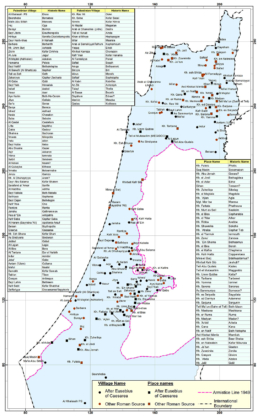
Palestine 313 AD
Shows 2000 year old Palestine villages during the Byzantine era and destroyed by Israel in 1948.
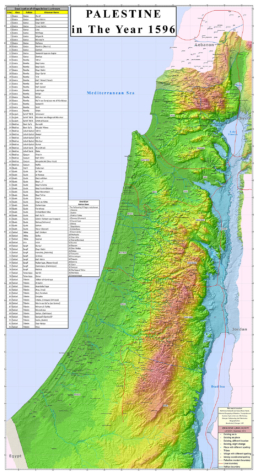
Palestine 1596
A rare map created from the Ottoman Tax Register of 1596 showing Palestine Localities in that year.
Traces of Poison – Israel’s Dark History Revealed
In the wake of Haifa's occupation on April 23 1948 by the Zionists, under the nose of the British Mandate forces commended by General Stockwell, a man still historically discredited for this failure, thousands converged to Acre, a nearby city, which was still Arab under the "protection" of the British forces.
Acre was to be the next Zionist target. The Zionists besieged the city from the land side and started showering the population with a hail of mortar bombs day and night. Famous for its historical walls, Acre could withstand the siege for a long time. The city’s water supply comes from a nearby village, Kabri, about 10 km to the north, through an aqueduct. The Zionists injected typhoid into the aqueduct at some intermediate point, which passes through Zionist settlements.
The ICRC and the Detention of Palestinian Civilians
The internment of thousands of Palestinian civilians in Israeli-run prisoner of war camps is a relatively little known episode in the 1948 war. This article begins to piece together the story from the dual perspective of the former civilian internees and of the International Committee of the Red Cross (ICRC). Aside from the day-to-day treatment of the internees, ICRC reports focused on the legal and humanitarian implications of civilian internment and on Israel’s resort to forced labor to support its war effort.
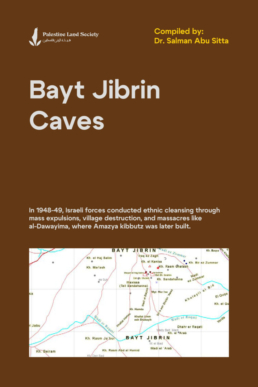
Bayt Jibrin Caves
The vast majority of Palestine’s population, including that in the highlands and the Shephelah apart from Jerusalem and outside the province of Jehud, continued in the land and began to prosper in the course of the Persian period. While the biblical books of Chronicles, Genesis, Isaiah, Jeremiah and Ezekiel present us with allegorical and utopian pictures of an ideal, repentant remnant of the people, returning to the land and reconciling all of Israel, the extensive archaeological excavations of Jerusalem and the area immediately surrounding it does not provide us with evidence that any significant return occurred historically during the Persian Period. The population of Jerusalem remained unchanged: limited to a few hundred. The population of the province of Jehud as a whole continued to be insignificant throughout the Persian and early Hellenistic periods.
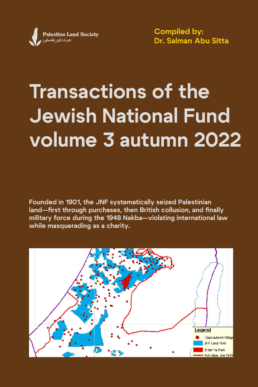
Transactions of the Jewish National Fund Volume 3 Autumn 2022
This paper demonstrates the treachery of the Jewish National Fund, in particular the UK branch that funded the planting
of Britannia Park (or British Park) over the ruins of seven Palestinian villages. Salman Abu-Sitta presents the JNF’s
treachery from three perspectives – stealing the land, burying villages and falsifying history.

Palestine
A map of Palestine showing locations and names of original villages and localities before Al Nakba pinpointing new colonies and massacres

Beer Sheba Tribal Lands
A map of Beer Sheba showing locations and names of original tribal lands
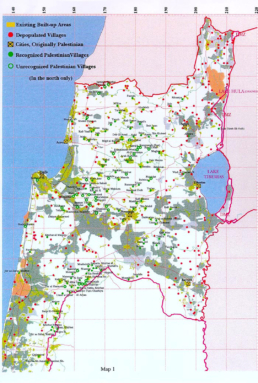
Al-Nakba and Return
A review of Palestinian life before 1948 showing its topography, its town and villages, plantation, costumes, transport and communication, Jerusalem doorways and streets.
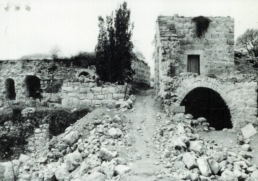
Al Nakba Anatomy
This is a very compelling and informative animation of the Zionist invasion of Palestine in 1948, in two-week intervals, showing the occupied areas, the depopulated villages, the expelled population and the Israeli military operations.